
Heteroecus pacificus
(Ashmead, 1896)
beaked spindle gall wasp
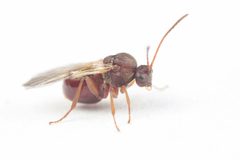
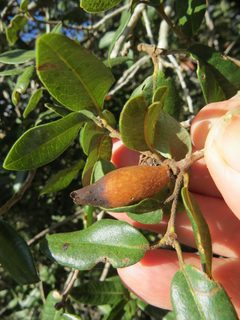
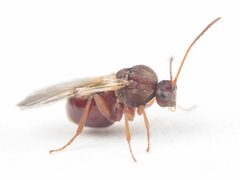
Heteroecus pacificus, commonly known as the beaked spindle gall wasp, is a of cynipid gall wasp native to western North America. It induces distinctive galls on canyon live oak (Quercus chrysolepis) and huckleberry oak (Quercus vaccinifolia). The species exhibits a complex with two : one sexual generation producing males and females, and one parthenogenetic generation consisting solely of females.
Pronunciation
How to pronounce Heteroecus pacificus: /hɛtɛroʊˈiːkəs pəˈsɪfɪkəs/
These audio files are automatically generated. While they are not always 100% accurate, they are a good starting point.
Identification
Parthenogenetic females measure 2.8–3.7 mm in length, while sexual females and males are smaller at 2.2–2.8 mm. The can be distinguished from other gall wasps by its specific association with Quercus chrysolepis and Q. vaccinifolia, and by the characteristic spindle-shaped galls it induces. Size dimorphism between provides a diagnostic feature when specimens are available.
Images
Habitat
Associated with oak woodlands and chaparral containing canyon live oak or huckleberry oak. Gall formation occurs on the foliage of trees.
Distribution
Western North America. Specific range details beyond this region are not documented in available sources.
Host Associations
- Quercus chrysolepis - gall canyon live oak
- Quercus vaccinifolia - gall huckleberry oak
Life Cycle
Two per year: one sexual generation with males and females, and one parthenogenetic generation with females only. Parthenogenetic females are larger than sexual individuals.
Ecological Role
Induces spindle-shaped galls on oak leaves. The ecological impacts of gall formation on host and interactions have not been quantified in available literature.
Human Relevance
No direct human relevance documented. Not a pest or beneficial of known economic importance.
Similar Taxa
- Other Heteroecus speciesSame , likely similar gall and oak associations; distinguished by host specificity and geographic range
- Other Cynipidae on QuercusMany cynipids induce galls on oaks; H. pacificus distinguished by its specific range (Q. chrysolepis, Q. vaccinifolia) and spindle gall
Sources and further reading
- BugGuide
- Wikipedia
- GBIF taxonomy match
- iNaturalist taxon
- NCBI Taxonomy
- It Started Out as a Quiet, End-of-the-Year Hike Near Lake Berryessa... | Bug Squad
- Spring Conditions Predict Following Year's Tick Activity in Northern California
- Cold-Season Temperature and Rainfall Drive Climate Suitability for Ticks in California
- CDC Study Shares County Maps of 7 Diseases Spread by Blacklegged Ticks
- Mapping Lyme: CDC Reveals Distribution of Lyme Disease-Causing Bacteria by County
- Ticks that Transmit Lyme Disease Reported in 48.6% of U.S. Counties