
Feron kingi
(Bassett, 1900)
Red Cone Gall Wasp
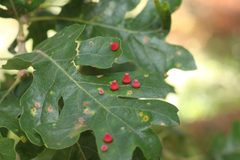
Feron kingi is a gall wasp in the Cynipidae that induces distinctive red, cone-shaped galls on white oak (Quercus sect. Quercus). The detachable galls, approximately 5 mm tall, house parthenogenetic females and typically form in clusters on both leaf surfaces. emerge from the tip of the cone in winter, an unusual seasonal pattern among cynipid . The species was originally described as Andricus kingi by Bassett in 1900 before transfer to Feron.
Pronunciation
How to pronounce Feron kingi: //ˈfɛrɒn ˈkɪn.dʒi//
These audio files are automatically generated. While they are not always 100% accurate, they are a good starting point.
Identification
The red cone galls are diagnostic: detachable, conical structures approximately 5 mm in height, bright red in color, with a pointed apex through which emerge. Galls form on both upper and lower leaf surfaces, often in dense clusters. The itself is small and rarely observed directly; identification relies primarily on gall and association with white oaks. Similar cone galls on oaks are induced by other cynipid , but the combination of red coloration, detachable nature, winter , and white oak host specificity distinguishes F. kingi.
Images
Habitat
Associated with white oak woodlands and savannas, particularly where valley oak (Quercus lobata) and related white oak occur. Galls form on living leaves in or subcanopy foliage.
Distribution
Western North America, with records concentrated in California and surrounding regions where white oak (Quercus sect. Quercus) are native. Specific range boundaries are incompletely documented.
Seasonality
emerge in winter from mature galls, with occurring through the tip of the cone. This winter activity pattern is atypical for most gall wasps, which more commonly emerge in spring or summer.
Host Associations
- Quercus lobata - gall inducervalley oak; primary documented
- Quercus - gall inducervarious white oak (sect. Quercus)
Life Cycle
Parthenogenetic females develop within the red cone galls. The appears to involve a single per year, with winter of . The sexual generation and alternate , if present, have not been documented; the may be and entirely parthenogenetic, or the sexual generation remains undescribed.
Behavior
Larval development occurs entirely within the enclosed gall structure. The detachable nature of the galls suggests possible abscission as a mechanism, though this has not been confirmed. emerge by chewing through the cone apex.
Ecological Role
As a gall inducer, modifies leaf tissue development to create protected microhabitats for offspring. Galls may serve as food sources for gall- insects or , though specific associates are undocumented. Contribution to nutrient cycling through gall and abscission is likely minor given small gall size.
Human Relevance
No direct economic importance. The distinctive galls are occasionally noted by naturalists and contribute to biodiversity awareness. No known impacts on oak health or forestry operations.
Similar Taxa
More Details
Taxonomic history
Originally described as Andricus kingi by Bassett (1900), later transferred to Feron based on biological and morphological characteristics. The Feron was historically synonymized with Andricus but has been reinstated in recent phylogenetic treatments.
Gall morphology
The cone gall structure is unique among western North American cynipids: a solid, woody, detachable cone with a central larval chamber. The red pigmentation is persistent and conspicuous, unlike the green or brown galls typical of related .