
Atrusca trimaculosa
(McCracken & Egbert, 1922)
Woollybear Gall Wasp
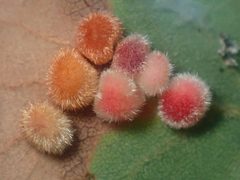
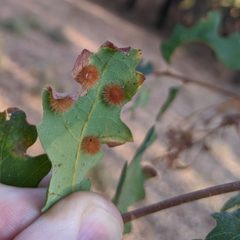
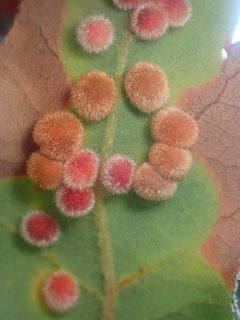
Atrusca trimaculosa, commonly known as the woollybear gall wasp, is a cynipid gall wasp that induces distinctive round, hairy galls on oak leaves. The galls are 3–4 mm wide, covered in stiff hairs, and typically clustered on leaf surfaces. Only females of this are known, suggesting may occur through . The species is associated with several oak species including valley oak, blue oak, and Oregon oak.
Pronunciation
How to pronounce Atrusca trimaculosa: //əˈtruskə ˌtrɪ.mæˈkjuː.lə.sə//
These audio files are automatically generated. While they are not always 100% accurate, they are a good starting point.
Identification
The galls of Atrusca trimaculosa are distinguished by their small size (3–4 mm), round shape, dense covering of stiff hairs, and clustered arrangement on oak leaves. The galls are located on leaf blades rather than midribs or twigs. holes may be visible on mature galls. The can be distinguished from other Atrusca species by gall and association.
Images
Habitat
Oak woodlands and forests where oak occur. The specifically utilizes valley oak (Quercus lobata), blue oak (Quercus douglasii), and Oregon oak (Quercus garryana) as hosts.
Distribution
Western North America, with records from California and Oregon corresponding to the ranges of its oak .
Host Associations
- Quercus lobata - gall valley oak
- Quercus douglasii - gall blue oak
- Quercus garryana - gall Oregon oak
Life Cycle
females emerge from galls and oviposit into oak leaf tissue. Larvae develop within the induced galls, secreting plant growth that cause the specialized gall structure to form. The galls provide shelter and nutrition for the developing larvae. Only females are known, suggesting the may proceed without males through .
Behavior
Females use their ovipositor to inject into leaf tissue, with the ovipositor functioning like a hypodermic needle. The is unable to sting humans.
Ecological Role
As a gall inducer, this manipulates plant growth to create specialized structures that support its development. The galls represent a form of plant–insect interaction where the redirects plant resources for its own benefit.
Human Relevance
The galls are occasionally noticed by naturalists and botanists studying oak . The has no known economic or medical significance.
Similar Taxa
- Atrusca quercuscentricolaAlso in Atrusca and induces galls on oaks, but produces more colorful, disc-shaped galls with distinct central depressions on post oak leaves
- Other CynipidaeNumerous cynipid induce oak galls, but differ in gall (shape, hairiness, location on plant), specificity, and