
Atrusca capronae
striped oak-apple gall wasp
Atrusca capronae, commonly called the striped oak-apple gall wasp, is a cynipid that induces characteristic galls on oak leaves in southwestern North America. The species is most frequently observed in Arizona but occurs throughout the region where its plants grow. The wasp's derives from the striped appearance of the galls it produces, though stripe intensity varies geographically. The species is considered fairly common within its range.
Pronunciation
How to pronounce Atrusca capronae: //əˈtɹʌskə ˈkæpɹəˌni//
These audio files are automatically generated. While they are not always 100% accurate, they are a good starting point.
Identification
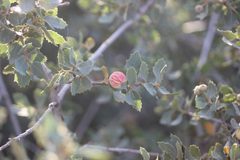
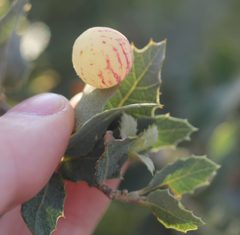
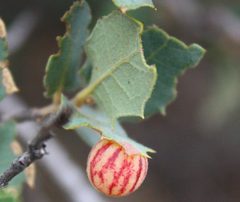
The is identified by the striped oak-apple galls it produces on oak leaves. The galls can be distinguished from other oak-apple galls by their characteristic striping; however, stripe intensity varies regionally, which may complicate identification in some areas. The specific host association with shrub live oak (Quercus turbinella) provides additional diagnostic context where this host is present.
Images
Appearance
are small, typical of cynipid gall wasps. The galls produced on oak leaves are the most visible manifestation of this —these are oak-apple type galls with distinctive striping, the intensity of which varies regionally. Gall coloration and pattern serve as the primary visual cue for field identification.
Habitat
Oak woodlands and scrublands supporting shrub live oak (Quercus turbinella) in arid and semi-arid regions of southwestern North America. The is tied to the presence of its specific plant, occurring in ranging from desert scrub to montane oak forests where this oak grows.
Distribution
Southwestern North America, with highest observation frequency in Arizona. The occurs throughout the range of its plant, shrub live oak, which extends from Arizona into adjacent portions of New Mexico, Texas, and northern Mexico.
Seasonality
are active during periods when oak leaves are suitable for oviposition, typically spring through early summer. Galls remain visible on leaves for extended periods. Specific data are limited.
Diet
Larval feed internally within the specialized gall tissue that the plant grows in response to wasp oviposition. The larvae do not consume normal leaf tissue directly; rather, they induce the plant to produce gall tissue that serves as their food source. wasps are not known to feed.
Host Associations
- Quercus turbinella - shrub live oak; primary plant for oviposition and gall development
Life Cycle
females oviposit into leaf tissue using their ovipositor. hatch into larvae that induce gall formation through secretion of plant growth-regulating substances. Larvae develop within the gall, feeding on the specialized gall tissue. Development completes with inside the gall, followed by adult through an exit hole chewed in the gall wall. The appears to be , with one per year typical for cynipid gall wasps in this region.
Behavior
females use their ovipositor to inject into leaf tissue; the ovipositor cannot sting humans. The 's entire is centered on gall induction and development, with larvae manipulating plant growth to create protected feeding chambers.
Ecological Role
As a gall-former, the acts as a plant that redirects plant resources to gall tissue. The galls may provide microhabitat for other organisms (, , ) within the broader oak gall , though specific associated species for A. capronae have not been documented.
Human Relevance
The has no known economic or medical importance. The galls are of interest to naturalists and entomologists studying plant-insect interactions and oak gall biodiversity. The poses no threat to humans—it cannot sting, and its galls do not significantly harm healthy oak trees.
Similar Taxa
- Other Atrusca speciescongeneric may produce similar oak galls; identification requires examination of gall and specificity
- Other cynipid oak-apple gall waspsnumerous Cynipidae induce oak-apple galls; A. capronae distinguished by striped gall pattern and association with shrub live oak
More Details
Taxonomic note
The Atrusca is part of the diverse Cynipidae , which contains thousands of gall wasp , most associated with oaks. The specific epithet capronae honors someone with the surname Capron, though the exact etymology is not recorded in available sources.
Research opportunities
Basic of this remains poorly documented, including precise , larval development duration, associations, and across its range.