
Antron quercusechinus
(Osten Sacken, 1870)
urchin gall wasp
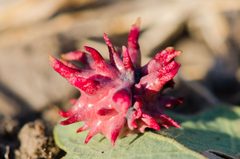
Antron quercusechinus is a gall-inducing cynipid that induces the distinctive 'urchin gall' on oak trees. The gall is spherical, approximately 1.5 cm in diameter, and covered with prominent spines that give it a sea urchin-like appearance. The primarily targets blue oaks (Quercus douglasii) but has been observed on other white oaks. Heavy can produce thousands of galls on individual trees.
Pronunciation
How to pronounce Antron quercusechinus: /ˈæntrɒn kwɜrkjuːsˈɛkɪnəs/
These audio files are automatically generated. While they are not always 100% accurate, they are a good starting point.
Identification
The itself is small and typical of cynipid , but the is most readily identified by its distinctive gall. The urchin gall is spherical, about 1.5 cm in diameter, with numerous radiating spines creating a sea urchin-like appearance. The gall is among the most visually striking oak galls, with dense spines covering the entire surface. This morphology distinguishes it from other spiny oak galls such as the spined turban gall, which is smaller, fleshier, and pink in coloration.
Images
Habitat
Associated with oak woodlands and savannas dominated by blue oak and other white oaks in California and adjacent regions.
Distribution
California and western North America; primarily associated with blue oak (Quercus douglasii) and other white oaks.
Host Associations
- Quercus douglasii - gall inductionprimary ; blue oak
- Quercus lobata - gall inductionvalley oak; secondary
- Quercus garryana - gall inductionOregon oak; secondary
Life Cycle
The female lays in actively growing oak tissue. Gall formation is triggered by substances in the female's saliva or fluids from the developing larva, which manipulate plant to induce tissue proliferation. The larva develops inside the gall, which provides both shelter and nutrition. The emerges from the gall after completing development. The specific timing of and whether the exhibits (as occurs in some related cynipids) has not been documented.
Behavior
Females are highly specific in oviposition site selection, targeting particular oak and tissue types. Heavy can produce thousands of galls on individual trees, indicating efficient location and utilization.
Ecological Role
As a gall inducer, the manipulates plant growth to create a protected microhabitat for its offspring. Dense gall may influence leaf function and tree resource allocation, though specific ecological impacts have not been quantified. The galls may provide or food sources for gall- species or , though specific associations are undocumented.
Human Relevance
The urchin gall is notable among naturalists and entomologists for its striking appearance. Ron Russo, author of a field guide to western plant galls, described it as 'the most striking galls that I have ever seen, and I think they are among the most bizarre galls on oaks in the world.' The has no documented economic importance.
Similar Taxa
- Disholcaspis quercusmammaAlso induces spherical galls on oaks, but produces 'oak apple' galls lacking the dense radiating spines characteristic of Antron quercusechinus.
- Acraspis macrocarpaeInduces jewel-like galls on bur oak leaves; galls are smooth, spherical, and multicolored rather than spiny.
- Andricus stellulusInduces stellar galls with hair-like stalks and toothed cups on desert oaks; entirely different from urchin galls.
More Details
Gall morphology significance
The urchin gall's distinctive spiny structure represents one of the most extreme examples of morphological manipulation of plant tissue by an insect. The functional significance of the spines—whether for defense against , physical protection, or other purposes—has not been investigated.