
Antron douglasii
(Ashmead, 1896)
Spined Turban Gall Wasp
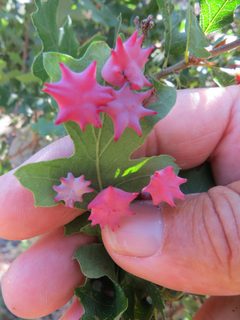
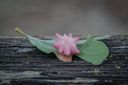
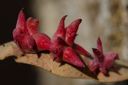
A cynipid gall wasp that induces distinctive spined turban galls on oak leaves. The galls are characterized by their fleshy, pink to reddish appearance with bristly projections. This is part of the highly diverse oak gall wasp fauna of western North America. The manipulates plant tissue development through chemical cues, though the precise mechanism remains unknown.
Pronunciation
How to pronounce Antron douglasii: /ˈæn.trɒn ˌduːˈɡlæ.si.aɪ/
These audio files are automatically generated. While they are not always 100% accurate, they are a good starting point.
Identification
The spined turban gall is fleshy and pink to reddish in color with bristly, spine-like projections covering its surface. The gall is relatively small and rounded with a turbinate (top-shaped) form. Galls occur on leaf surfaces, sometimes covering entire leaves in heavy . The is minute and difficult to distinguish from related without microscopic examination; identification typically relies on gall .
Images
Habitat
Associated with oak woodlands and savannas where oaks occur. Found in Mediterranean-type climates of western North America.
Distribution
Western North America, primarily California. Associated with blue oak (Quercus douglasii) and valley oak (Q. lobata) ranges.
Host Associations
- Quercus douglasii - induces galls on leavesprimary
- Quercus lobata - induces galls on leavessecondary
Behavior
Females lay in actively growing oak leaf tissue. Developing larvae induce gall formation through salivary secretions that manipulate plant and . The gall provides both shelter and nutrition for the developing larva.
Ecological Role
Acts as a gall inducer that stimulates localized plant tissue proliferation. The galls serve as microhabitats supporting and within the oak gall . Heavy can cover entire leaf surfaces, though impacts on overall tree health are generally minimal.
Human Relevance
Contributes to the diversity of plant galls studied for understanding insect-plant chemical interactions. The distinctive galls are of interest to naturalists and educators. No significant economic impact on oak forestry or agriculture.
Similar Taxa
- Antron quercusechinusAlso induces galls on blue oak and other white oaks, but produces the urchin gall—a larger (1.5 cm diameter), more spherical gall with prominent spines rather than the smaller, bristly turban form.
- Trichoteras spp.Other cynipids induce crystalline galls on oaks, but these appear as bristly red or pink caterpillar-like projections covering leaf surfaces, distinct from the discrete turban-shaped galls of A. douglasii.