
Andricus vacciniifoliae
Golden Oak Apple Gall Wasp, Golden Oak Apple Wasp
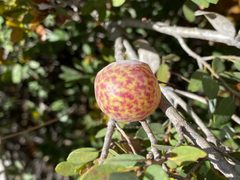
Andricus vacciniifoliae is a gall-forming cynipid native to the west coast of North America. The creates distinctive stem galls on huckleberry oak (Quercus vacciniifolia) and canyon live oak (Quercus chrysolepis). The galls are colorful and fruit-like in appearance, often leading to misidentification as actual fruit. The wasp has been reclassified from Andricus to Trichoteras in some taxonomic treatments, though both names remain in use.
Pronunciation
How to pronounce Andricus vacciniifoliae: //ˈændrɪkəs vækˌsɪniɪˈfoʊli.i//
These audio files are automatically generated. While they are not always 100% accurate, they are a good starting point.
Identification
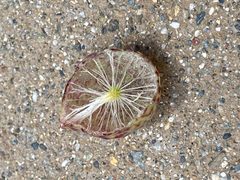
The galls produced by this are stem galls, not leaf galls, which distinguishes them from many other Andricus species. The galls are colorful, round to apple-shaped structures that attach directly to stems of the oak. The larval chamber is positioned centrally within the gall, connected to the outer husk by slender radiating structures. The galls are often mistaken for fruit due to their appearance and location on the plant.
Images
Habitat
Associated with huckleberry oak and canyon live oak in western North American oak woodlands and chaparral. The oaks typically occur in dry, rocky slopes and montane environments where these oak are native.
Distribution
Native to the west coast of North America. The ' range corresponds to that of its oaks, Quercus vacciniifolia and Quercus chrysolepis, in California and Oregon.
Host Associations
- Quercus vacciniifolia - huckleberry oak; primary for gall formation
- Quercus chrysolepis - canyon live oak; secondary
Similar Taxa
- Other Andricus speciesMany Andricus produce oak galls, but A. vacciniifoliae is distinguished by producing stem galls rather than leaf galls, and by its specific association with huckleberry oak and canyon live oak rather than other oak species.