
Andricus opertus
Fimbriate Gall Wasp
Andricus opertus is a cynipid gall wasp that induces distinctive galls on California oaks. The exhibits , with bisexual and unisexual forms producing different gall types. The bisexual creates elongate, spiky leaf galls, while the unisexual generation forms aborted bud galls. This species is part of the highly diverse Andricus , which contains numerous oak-associated gall wasps.
Pronunciation
How to pronounce Andricus opertus: /ˈæn.drɪ.kʊs oʊˈpɜr.təs/
These audio files are automatically generated. While they are not always 100% accurate, they are a good starting point.
Identification
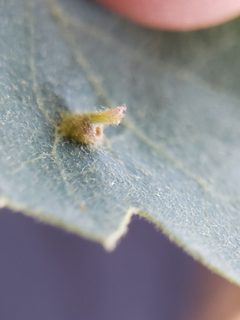
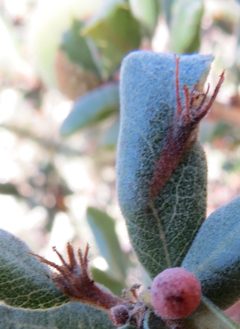
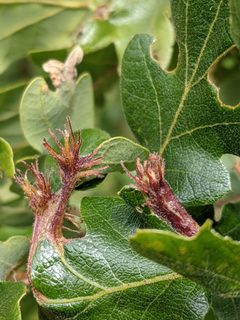
The bisexual produces elongate, spiky leaf galls that are distinctive in shape. These galls form on oak leaves and persist from spring through fall. The unisexual generation forms aborted bud galls during summer and fall, which differ markedly from the leaf galls. Specific identification of the requires examination of morphological characters not described in available sources.
Images
Habitat
Associated with oak woodlands in California, specifically on valley oak (Quercus lobata) and scrub oak (Quercus berberidifolia and related ). The species requires actively growing oak tissues for gall induction.
Distribution
California, USA. Documented on various oak in this region.
Seasonality
Bisexual galls form in spring, with in late spring. Galls persist on trees until fall. Unisexual generation forms aborted bud galls in summer and fall.
Host Associations
- Quercus lobata - valley oak
- Quercus berberidifolia - scrub oak
- Quercus - various oak
Life Cycle
with distinct bisexual and unisexual forms. Bisexual : females lay in developing oak leaves in spring, inducing elongate spiky galls; larvae develop inside, emerge late spring. Unisexual generation: produces aborted bud galls in summer and fall; details of this generation's development are not fully described in available sources.
Behavior
Females use their ovipositor to inject into plant tissue, triggering gall formation through chemical secretions that manipulate plant growth.
Ecological Role
As a gall inducer, creates specialized microhabitats on oak trees that may provide shelter and food for other organisms. Part of the complex of gall-forming insects associated with California oak .
Human Relevance
No significant direct human impact documented. Like other cynipid , contributes to oak biodiversity and serves as a subject for ecological and evolutionary studies of plant-insect interactions.
Similar Taxa
- Andricus dimorphusAlso in Andricus and induces leaf galls on oaks, but produces clustered midrib galls rather than elongate spiky galls
- Andricus pattoniAnother Andricus on oaks, but produces different gall on post oak
- Other Andricus speciesNumerous induce galls on oaks; specific gall and association are primary distinguishing features
More Details
Gall morphology
The bisexual galls are described as 'elongate' and 'spiky' or 'fimbriate' (fringed), giving the its . This distinguishes them from the rounded or bullet-shaped galls of related species like Disholcaspis quercusglobulus.
Generation alternation
The alternation between bisexual (sexual) and unisexual (parthenogenetic) is characteristic of many Cynipidae, though the specific triggers and mechanisms remain incompletely understood for this .