
Amphibolips quercusfuliginosa
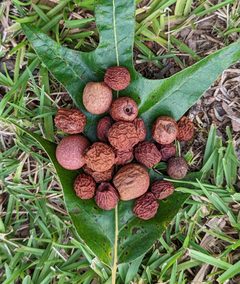
Amphibolips quercusfuliginosa is a of gall wasp in the Cynipidae. It induces galls on oak species (Quercus), with the specific epithet referencing the sooty or dark appearance of the gall structures. The species belongs to a known for producing complex, often spherical galls on oaks. It is part of the diverse North American cynipid fauna associated with white oaks.
Pronunciation
How to pronounce Amphibolips quercusfuliginosa: /æmˈfɪbəlɪps kwɜːrkəsˌfjuːlɪdʒɪˈnoʊsə/
These audio files are automatically generated. While they are not always 100% accurate, they are a good starting point.
Identification
Identification relies primarily on gall and association rather than features. The galls are small, spherical to slightly irregular, and dark-colored, occurring on oak leaves. Distinguishing from other Amphibolips requires examination of gall structure, location on leaf (upper vs. lower surface), and specific host oak species. Adult wasps require identification using microscopic features of , wing venation, and body .
Images
Habitat
Deciduous forests and woodlands containing oak (Quercus), particularly white oaks (Quercus section Quercus). Found in areas with mature oak trees where galls can develop on leaves.
Distribution
North America, with records primarily from eastern and central United States where oaks are abundant. Specific range boundaries not well documented.
Seasonality
timing not precisely documented; likely spring to early summer corresponding with oak leaf development and gall maturation. Galls visible on leaves during growing season.
Host Associations
- Quercus - Induces galls on leaves of oak , particularly white oaks.
Life Cycle
Ecological Role
Forms galls that provide microhabitats for and within the oak gall . Contributes to the complex associated with cynipid galls on oaks.
Human Relevance
No significant direct economic impact. Of interest to entomologists and naturalists studying gall wasp diversity and oak-associated .
Similar Taxa
- Amphibolips quercusostensackeniiAlso produces dark, spherical galls on white oak leaves; requires careful comparison of gall size, surface texture, and exact for separation.
- Amphibolips quercusinanisSimilar gall on oaks; distinguished by gall internal structure and morphological features.
- Other Amphibolips speciesMany Amphibolips produce leaf galls on oaks; species-level identification depends on gall characteristics and microscopic examination of .
More Details
Etymology
The specific epithet 'quercusfuliginosa' combines 'quercus' (oak, the plant) with 'fuliginosa' (sooty, referring to the dark coloration of the gall).
Gall characteristics
The gall is integral to identification. Galls are typically single-chambered, located on oak leaf blades, and mature to a dark color. Detailed gall descriptions in primary taxonomic literature should be consulted for precise identification.