
Cerceris bicornuta
Guérin-Méneville, 1844
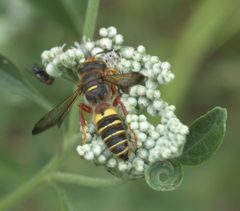
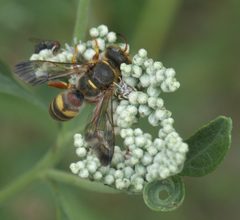
Cerceris bicornuta is a solitary digger wasp in the Crabronidae. It is a large with distinctive orange and white markings, occurring throughout much of North America with particular abundance in the southeastern United States. The species is a of weevils in the Sphenophorus, which it paralyzes with its sting and provisions in underground nests for its offspring.
Identification
Cerceris bicornuta is a large digger wasp, over one inch in length, with distinctive orange and white alternating stripes on the . It can be distinguished from the similar Cerceris fumipennis by its prey association: C. bicornuta specializes on weevils rather than jewel beetles, and weevils rather than buprestids will be found near its nest entrances. Its burrow entrances appear slightly larger on average than those of C. fumipennis, though this is not a consistent distinguishing character. The exhibits a faster, more powerful than C. fumipennis, making it more difficult to capture.
Images
Habitat
Nests are constructed in well-packed sandy soil in sunny, open areas. Suitable sites include ball fields, dirt roads, playgrounds, and other locations with lightly vegetated, sandy or sandy-clay soil.
Distribution
Found throughout much of North America, with particular abundance in the southeastern United States. Records extend from the eastern and central United States southward through Central America.
Diet
of weevils in the Sphenophorus. The paralyzes prey with its sting but does not kill it, then provisions underground nest with the immobilized weevils for larval consumption.
Host Associations
- Sphenophorus - preyWeevil ; primary prey of this
Behavior
Solitary nesting that excavates burrows in sandy soil. Multiple nests may be loosely aggregated in favorable locations. The wasp captures prey in , paralyzes it with its sting, and transports it back to the nest. When threatened, wasps may drop prey and abandon it rather than retrieve it. Burrow entrances are perfectly circular and pencil-sized, surrounded by symmetrical mounds of fine-textured diggings.
Ecological Role
controlling of Sphenophorus weevils. As a solitary , it contributes to local biodiversity and serves as potential prey for kleptoparasites such as mutillid wasps.
Human Relevance
May be encountered by entomologists and naturalists in sandy . The is not known to sting humans even when handled. Its nesting habits in ball fields and similar open areas may bring it into casual contact with people, though it poses no threat.
Similar Taxa
- Cerceris fumipennisSimilar burrow architecture and nesting habits, but specializes on Buprestidae (jewel beetles) rather than weevils. C. fumipennis has smoky wings (hence 'smoky-winged beetle bandit') and exhibits slower, less powerful .
- Cerceris bicornisAnother weevil with nearly identical burrow appearance; may be or closely related. Distinguishing these reliably may require examination of prey or detailed morphological analysis.
More Details
Taxonomic Note
The epithet 'bicornuta' refers to a two-horned characteristic, likely describing a morphological feature of the female. The species was described by Guérin-Méneville in 1844.
Sources and further reading
- BugGuide
- Wikipedia
- GBIF taxonomy match
- iNaturalist taxon
- Catalogue of Life
- Haldeman’s shieldback katydid (Pediodectes haldemani) | Beetles In The Bush
- Working with Cerceris fumipennis—Epilogue | Beetles In The Bush
- Working with Cerceris fumipennis—Part 2 | Beetles In The Bush
- Working with Cerceris fumipennis—Part 1 | Beetles In The Bush
- Wasp, Geographic Data Improve Surveillance for Emerald Ash Borer
- Predatory Wasps and Citizen Scientists are Taking on the Emerald Ash Borer