
Mellinus abdominalis
Cresson, 1882
Mellinus abdominalis is a of digger wasp in the Crabronidae, first described by Cresson in 1882. It is a rarely observed species native to North America, with confirmed records from Alberta, Canada. Like other members of the Mellinus, it is presumed to be a of muscoid flies, though specific biological observations for this species remain undocumented. The species is part of a small genus of solitary that excavate burrows in sandy soil and provision with paralyzed fly prey.
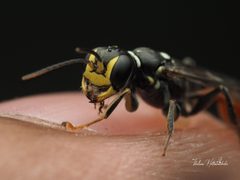
Pronunciation
How to pronounce Mellinus abdominalis: //mɛˈliːnəs æbˈdɒmɪˌneɪlɪs//
These audio files are automatically generated. While they are not always 100% accurate, they are a good starting point.
Identification
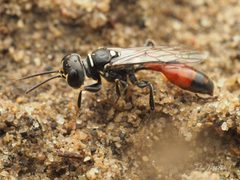
Distinguished from other Mellinus by abdominal coloration and pattern; M. abdominalis has a black body with red coloration on the . Distinguished from the similar-sized crabronine by the (stalked) abdomen. Females may be observed carrying paralyzed flies grasped by the mouthparts. The Mellinus is distinguished from similar small fly-hunting wasps by this petiolate abdomen character, not shared by other fly of comparable size (8-10 mm).
Images
Habitat
Sandy soils suitable for burrow excavation; specific associations for this are undocumented, though inhabit areas near fresh manure where prey flies are abundant.
Distribution
North America; confirmed records from Alberta, Canada.
Ecological Role
Presumed of muscoid flies (house flies and kin), potentially contributing to of filth fly , though this role has been documented only for European .
Human Relevance
Potential value for of filth flies in rural contexts, though the is too rarely observed to be practically employed.
Similar Taxa
- Mellinus arvensisEuropean with well-documented ; differs in distribution and likely subtle morphological characters.
- Mellinus bipunctatusNorth American , also rarely observed; distinguished by specific abdominal markings.
- Mellinus imperialisNorth American found in southwestern United States; distinguished by distribution and coloration pattern.