
Mellinus
Fabricius, 1790
Species Guides
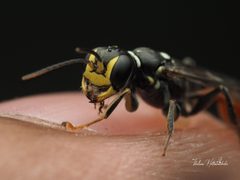
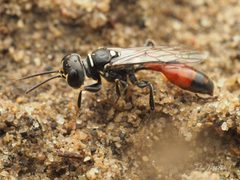
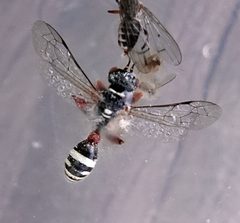
4Mellinus is a of solitary digger wasps in the Crabronidae, containing approximately 16-18 described distributed across the Palearctic, Nearctic, Neotropical, and Oriental regions. These small (8-10 mm) are specialized of muscoid flies, which they hunt primarily near fresh manure and other fly-aggregating resources. Females excavate burrows in sandy soil to provision with paralyzed flies for their larvae. The genus is notable for its distinctive and feline-like stalking when capturing prey.
Pronunciation
How to pronounce Mellinus: /mɛˈliːnʊs/
These audio files are automatically generated. While they are not always 100% accurate, they are a good starting point.
Identification
The is the key diagnostic feature distinguishing Mellinus from other small crabronid that prey on flies. Similar-sized members of tribe Crabronini lack this stalked abdominal structure. When observing hunting , the combination of small size, fly prey, and feline stalking posture (slow creeping followed by pouncing) strongly suggests Mellinus. Examination of wing venation and abdominal structure is necessary for definitive identification to .
Images
Appearance
Small measuring 8-10 millimeters in length. Possess a distinctly (stalked) , a character that separates them from similar-sized fly . Body form is slender with a constricted waist between and abdomen. Coloration and specific markings vary by ; some species such as M. imperialis may show distinctive color patterns. Wings are membranous and folded longitudinally at rest.
Habitat
Sandy or loose soil substrates suitable for burrow excavation. Nesting frequently occur in open, sun-exposed areas with sparse vegetation. are most commonly encountered in the vicinity of fresh manure, carrion, or other substrates that attract muscoid flies. include rural and agricultural areas, recreation areas near water courses, and other locations where both suitable soil and fly coincide.
Distribution
Palearctic, Nearctic, Neotropical, and Oriental zoogeographic regions. In Europe, at least two occur: M. arvensis and M. crabroneus. North American records include M. bipunctatus and M. imperialis, with the latter documented from Arizona. A M. arvensis obscurus has been recorded from Nepal.
Seasonality
Activity period varies by region and . In temperate zones, are active during warmer months when fly prey is abundant. The European species M. arvensis shows extended activity during the season. Spring specimens may be encountered in appropriate ; specific seasonal patterns for most species remain poorly documented.
Diet
Specialized of muscoid flies (Diptera: Muscoidea), including house flies and related filth flies. Females provision nest with 4-9 paralyzed flies per cell, laying an on the final victim. Prey is captured by stalking from behind, pouncing to pin the wings, then stinging ventrally to subdue.
Life Cycle
Complete with solitary nesting . Females excavate burrows 30-50 cm deep in sandy soil, terminating in 1-10 individual . Each cell receives 4-9 paralyzed flies as larval provisions. An is deposited on the last prey item in each cell. Cells are sealed with earthen plugs upon completion, while the main tunnel entrance remains open during hunting periods. Larvae feed on the provided flies, pupate within the cell, and emerge as . Mature larvae have been described for at least one .
Behavior
Females exhibit two alternative nesting strategies: digging new burrows or searching for and usurping unoccupied existing burrows. The latter strategy leads to frequent aggressive interactions between searching females and nest owners at burrow entrances; residency status and body size confer advantage in these contests. Males establish territories near fresh manure and intercept females for mating. Hunting involves distinctive stalking: the creeps slowly behind a fly, then pounces to pin the wings while delivering a sting. Subdued prey is turned over, grasped by the mouthparts, and flown to the nest.
Ecological Role
of muscoid flies, potentially contributing to of filth fly in rural and agricultural settings. As a soil-nesting insect, may contribute to soil aeration through burrowing activity.
Human Relevance
Potential value as agents for filth flies (house flies and relatives) that affect rural . Not known to sting humans aggressively; stings are used primarily for prey subdual. Rarity of most limits practical application for pest control.
Similar Taxa
- Crabronini (tribe)Similar small size and fly-hunting , but lack the diagnostic of Mellinus; abdomen is or only slightly constricted.
- Other small CrabronidaeMany small crabronids hunt flies, but the combination of and specific hunting posture distinguishes Mellinus.
More Details
Nesting strategy plasticity
Individual females can switch between digging new nests and searching for existing burrows. Soil hardness influences the relative costs of these strategies: harder soils increase the time cost of digging, favoring more frequent nest searching and consequently higher rates of aggressive encounters between females.
Body size and soil hardness
Female body size correlates with soil hardness at nesting sites. Harder substrates favor larger body size due to increased selective advantage in aggressive contests. Body size is determined by larval food availability, creating a trade-off between provisioning few with abundant food (producing few large offspring) versus many cells with sparse provisions (producing many small offspring).
Taxonomic note
placement has been subject to revision; some sources list Mellinidae as the family, while current classifications (iNaturalist, Catalogue of Life) place the in Crabronidae, Mellininae.
Rarity and documentation
Most are rarely encountered and poorly known biologically. The European M. arvensis is anomalously common compared to . North American records are sparse and often represent significant range extensions when documented.
Sources and further reading
- BugGuide
- Wikipedia
- GBIF taxonomy match
- iNaturalist taxon
- NCBI Taxonomy
- Catalogue of Life
- On a Winning Streak! | Bug Squad
- Bug Squad
- Bug Eric: Wasp Wednesday: Mellinus
- Effect of soil hardness on aggression in the solitary wasp Mellinus arvensis
- NESTING BIOLOGY, MORPHOLOGICAL REMARKS, AND DESCRIPTION OF THE MATURE LARVA OF MELLINUS ARVENSIS OBSCURUS (HYMENOPTERA: CRABRONIDAE) IN NEPAL