
Plenoculus davisi
W. Fox, 1893
square-headed wasp
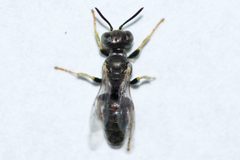
Plenoculus davisi is a of square-headed wasp in the Crabronidae, first described by W. Fox in 1893. The species is native to North America, with records from Canada and the United States. Five have been recognized: P. d. atlanticus, P. d. davisi, P. d. gracilis, P. d. mojavensis, and P. d. transversus. As a member of the Miscophini tribe, it belongs to a group of solitary that are typically predatory on other insects.
Pronunciation
How to pronounce Plenoculus davisi: //plɛˈnɒkjʊləs ˈdeɪvɪsaɪ//
These audio files are automatically generated. While they are not always 100% accurate, they are a good starting point.
Identification
Members of the Plenoculus can be recognized by their square-headed , a characteristic feature of the Miscophini tribe within Crabronidae. The five of P. davisi are distinguished primarily by geographic distribution and subtle morphological differences: P. d. atlanticus (eastern North America), P. d. davisi (nominate subspecies), P. d. gracilis, P. d. mojavensis (Mojave Desert region), and P. d. transversus. Specific diagnostic features for separating P. davisi from and distinguishing among its subspecies require examination of detailed morphological characters not fully documented in available sources.
Images
Distribution
North America. Documented from Canada (Alberta) and the United States. The show regional differentiation: P. d. atlanticus in eastern regions, P. d. mojavensis in the Mojave Desert area, and P. d. transversus and P. d. gracilis in other parts of the range.
Similar Taxa
- Other Plenoculus species share the square-headed characteristic of the ; precise differentiation requires examination of specific morphological characters.
- Other Miscophini waspsMembers of this tribe share general body plan and predatory habits; -level identification relies on shape and other structural features.
More Details
Subspecies
Five are currently recognized: Plenoculus davisi atlanticus Viereck, 1902; Plenoculus davisi davisi W. Fox, 1893 (nominate); Plenoculus davisi gracilis F. Williams, 1960; Plenoculus davisi mojavensis F. Williams, 1960; and Plenoculus davisi transversus F. Williams, 1960. The subspecies were described by F. Williams in 1960 based on geographic and morphological variation.