
Tachytes intermedius
(Viereck, 1906)
square-headed wasp
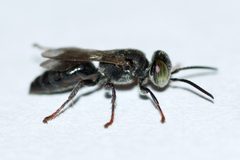
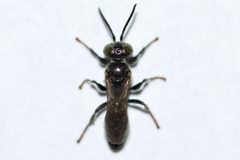
Tachytes intermedius is a of square-headed wasp in the Crabronidae, distributed across Central America and North America. As a member of the Tachytes, it shares the characteristic large green found in many larger species of this group. The species was described by Viereck in 1906. Like other Tachytes, it is a solitary that nests in soil and provisions its burrows with paralyzed orthopteran prey.
Pronunciation
How to pronounce Tachytes intermedius: /ˈtæ.kɪ.tiːz ˌɪn.tərˈmiː.di.əs/
These audio files are automatically generated. While they are not always 100% accurate, they are a good starting point.
Identification
Members of Tachytes can be distinguished from related such as Liris and Tachysphex by their stockier build and frequently bright green . Tachytes intermedius specifically may require examination of male genitalia for definitive identification, as is common for many insects in this group. The combination of large green eyes, square , and stocky body separates Tachytes from the more slender Liris with longer , and from the smaller Tachysphex which often has red abdominal coloration.
Images
Appearance
As a Tachytes , individuals likely exhibit the -typical large that are often green in color, especially prominent in males. The body is generally stocky in build. The is characteristically square-shaped, giving the to members of this genus. Males possess very large relative to body size. The ocellar scars, reduced to small marks typical of the Larrini tribe, are shaped like golf clubs with long tails running partway down the head.
Habitat
Nests are excavated in soil, with burrow entrances sometimes located just inside the entrances of burrows made by other organisms such as rodents, lizards, or cicada killer . Nesting sites occur in various soil types, not exclusively sand. Males perch on stones, leaves, flowers, or twigs while defending territories.
Distribution
Found in Central America and North America. Specific records include the United States, with observational reports from Massachusetts, Colorado, and other regions.
Diet
feed on flower nectar. Females provision nest with paralyzed orthopterans including grasshoppers (Acrididae), pygmy grasshoppers (Tetrigidae), nymphs (Tettigoniidae), or pygmy mole crickets (Tridactylidae).
Host Associations
- Acrididae - prey grasshoppers provisioned in nest
- Tetrigidae - preypygmy grasshoppers provisioned in nest
- Tettigoniidae - prey nymphs provisioned in nest
- Tridactylidae - preypygmy mole crickets provisioned in nest
Life Cycle
Females excavate burrows 7 centimeters to nearly one meter in length, reaching depths of 7.5 to 70 centimeters. Several individual are arranged along the main burrow or at the ends of branching tunnels. Each cell receives one to thirteen paralyzed prey items, with an laid on the last victim. Males emerge before females and initially defend territories near female sites, later shifting to territories around nesting sites.
Behavior
Females hunt orthopteran prey, paralyzing victims with their sting, then straddling the prey and grasping it by the with their jaws to transport it back to the nest. Males employ two mate-finding strategies: early-season defense of territories near female sites, and later defense of territories around nesting sites and nectar resources. Males perch on elevated substrates and scan for females or rivals. When a female is detected, the male pounces on her back, pinning her wings, and initiates courtship involving antennal waving.
Ecological Role
As a of orthopterans, this helps regulate of grasshoppers, crickets, and related insects. may contribute to pollination through nectar feeding. The species serves as prey for various and including satellite flies and velvet ants that attack their nests.
Human Relevance
Generally docile and not aggressive toward humans. Solitary rarely sting unless handled. May be observed visiting flowers in gardens and natural areas. Sometimes mistaken for more aggressive social wasps, leading to unnecessary concern.
Similar Taxa
- Tachytes distinctusSimilar member with large green ; may require genital dissection for separation
- Liris argentatusAlso in tribe Larrini and active in spring, but more slender with proportionately longer and silvery reflective hairs rather than green
- TachysphexRelated in same tribe, but usually smaller with often red or partly red and very pointed
More Details
Nesting biology
Based on studies of Tachytes intermedius specifically (Kurczewski & Kurczewski 1984), this exhibits the typical Tachytes nesting with burrows constructed in soil and provisioned with paralyzed orthopteran prey.
Taxonomic note
The was originally described in the Sphecidae, but is now classified in Crabronidae following modern phylogenetic revisions of the superfamily .
Sources and further reading
- BugGuide
- Wikipedia
- GBIF taxonomy match
- iNaturalist taxon
- Catalogue of Life
- Bug Eric: Green-eyed Wasps, Tachytes
- Bug Eric: Wasp Wednesday: Liris
- Bug Eric: About
- Captive-bred population could save endangered crocodile from extinction
- Bug Eric: White Prairie Clover: An Awesome Blossom
- Bug Eric: The Tarantula Hunt