
Lindenius
Lepeletier de Saint Fargeau & Brullé, 1835
Species Guides
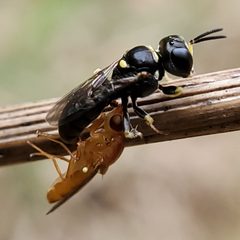
1Lindenius is a of solitary in the Crabronidae containing 63 known , predominantly distributed in the Palearctic with some Nearctic representatives. Species exhibit diverse prey specialization: L. pygmaeus armatus hunts chalcid wasps (primarily Pteromalidae), while L. albilabris preys on paralyzed spiders. Nests are excavated in sandy or loess soils, with burrows containing multiple provisioned with prey items. are active from late May to late July and visit flowers for nectar.

Pronunciation
How to pronounce Lindenius: //lɪnˈdeː.ni.us//
These audio files are automatically generated. While they are not always 100% accurate, they are a good starting point.
Images
Habitat
Sandy areas, wasteland, and non-vegetated sites with hardened or sandy-clay soil; nesting substrate includes loess and flat to slightly sloping terrain. Nests are excavated in soil with burrows approximately 2.5 mm in diameter and 8–10 cm deep.
Distribution
Primarily Palearctic; some in the Nearctic. Documented in northern Poland (Kowalewo Pomorskie, Sierakowo), with L. p. armatus distributed across Europe excluding northern Africa, the Iberian Peninsula, France, and Italy. GBIF records from Denmark, Norway, and Sweden.
Seasonality
active from late May to late July.
Diet
Prey specialization varies by : L. pygmaeus armatus hunts chalcid wasps (Hymenoptera: Chalcidoidea, primarily Pteromalidae), averaging 14 prey items per ; L. albilabris provisions cells with single paralyzed spiders. feed on nectar from flowers including Achillea millefolium, Peucedanum oreoselinum, Daucus carota, and Tanacetum vulgare.
Host Associations
- Pteromalidae: Coelopisthia extenta - preyparalyzed and stored in nest
- Pteromalidae: Cyclogastrella simplex - preyparalyzed and stored in nest
- Pteromalidae: Cyrtogaster vulgaris - preyparalyzed and stored in nest
- Pteromalidae: Dibrachys cavus - preyparalyzed and stored in nest
- Pteromalidae: Meraporus graminicola - preyparalyzed and stored in nest
- Pteromalidae: Psychophagus omnivorus - preyparalyzed and stored in nest
- Pteromalidae: Pteromalus sp. - preyparalyzed and stored in nest
- Pteromalidae: Stenomalina gracilis - preyparalyzed and stored in nest
- Pteromalidae: Trichomalus perfectus - preyparalyzed and stored in nest
- Myrmosa atra - observed entering burrows of L. pygmaeus armatus
- Senotainia conica - kleptoparasiteobserved entering burrows of L. pygmaeus armatus
- spiders - preyparalyzed and stored in as larval food for L. albilabris
Life Cycle
Females excavate burrows leading to 3–5 (L. pygmaeus armatus) or 1–3 cells (L. albilabris). is deposited at base of prey or on paralyzed spider. Larva consumes provisions in approximately 5 days. Cocoon formed from silk threads covered with fragments of prey, measuring 5–7 mm long and 2.5–3.5 mm wide.
Behavior
Females transport prey in using middle and hind legs. Extremely cautious nest entry with winding detours even when no kleptoparasites are present. Nest entrance remains open during provisioning. Females wait out unfavorable weather inside nest. Provisioning frequency averages 3–15 minutes (typically ~5 minutes). Nests often clustered, with 2 nests documented per 20 cm². Excavated soil forms small mound around entrance.
Ecological Role
of chalcid wasps and spiders; potential agent for pest . Prey for (Myrmosa atra) and kleptoparasites (Senotainia conica). through flower visitation. Soil-nesting activity contributes to nutrient cycling and soil aeration.
More Details
Phylogenetic relationships
L. pygmaeus is sister to L. panzeri based on COI barcode data. Possible cryptic speciation indicated in Western Palearctic Lindenius , requiring further study with additional markers and larger .
Sources and further reading
- BugGuide
- Wikipedia
- GBIF taxonomy match
- iNaturalist taxon
- NCBI Taxonomy
- Catalogue of Life
- Nesting behaviour and description of mature larva of Lindenius albilabris (Fabricius, 1793) (Hymenoptera: Crabronidae)
- Nesting biology and phylogenetic relationships of the parasitoid-hunting wasp Lindenius pygmaeus armatus (Vander Linden, 1829) (Hymenoptera: Crabronidae)