
Myrmosa
Latreille, 1796
Species Guides
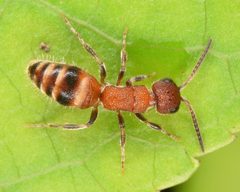
2Myrmosa is a of solitary in the Myrmosidae. These insects are part of a small family of wasps that exhibit and unusual traits. The genus contains several described , including Myrmosa atra, Myrmosa moesica, and Myrmosa unicolor. Taxonomic placement has been historically unstable, with some sources placing Myrmosidae as a within Mutillidae.
Pronunciation
How to pronounce Myrmosa: /mɪrˈmo.sa/
These audio files are automatically generated. While they are not always 100% accurate, they are a good starting point.
Identification
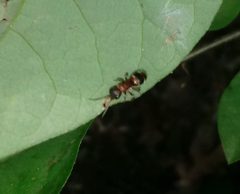
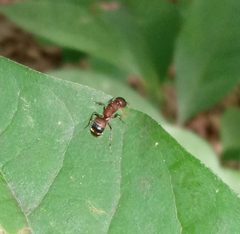
Myrmosa females are wingless and -like in appearance, resembling velvet ants (Mutillidae). Males possess wings and differ markedly from females. This extreme can lead to males and females of the same being described separately. The wingless female distinguishes Myrmosa from most other winged Hymenoptera, though careful examination is needed to separate them from Mutillidae.
Images
Distribution
Recorded from northern Europe (Denmark, Norway, Sweden) and northeastern North America (Vermont, United States).
Life Cycle
Myrmosidae are with complex . Females are known to parasitize larvae of other , particularly crabronid wasps in the tribe Bembicini. The wingless female searches for in soil or sand, where she deposits an on the host larva.
Behavior
Females are ground-dwelling and search for nests on foot. Males are winged and likely search for females for mating. The wingless condition of females is an for entering host burrows.
Ecological Role
of other solitary , contributing to of their .
Similar Taxa
- MutillidaeVelvet ant females are also wingless and -like; Myrmosa females closely resemble mutillids in general appearance. Myrmosidae can be distinguished by wing venation in males and other morphological details.
- SapygidaeAnother with wingless females that parasitize and nests; similar ecological role and use.
More Details
Taxonomic uncertainty
placement has been debated. Myrmosidae has been treated as a of Mutillidae in some classifications, which explains why NCBI and GBIF may list Mutillidae as the family. Current consensus treats Myrmosidae as a distinct family.