
Bembecinus quinquespinosus
(Say, 1823)
Bembecinus quinquespinosus is a small sand wasp, approximately 8–10 mm in length, belonging to the Crabronidae. The exhibits notable in coloration and mating . Females construct burrows in sandy substrates and practice , hunting leafhoppers to feed their larvae. Males employ alternative mating tactics based on body size: large males dig for emerging females at nest , while smaller males patrol peripherally to intercept departing females. The species is native to the Americas, with a broad distribution spanning North America, Central America, South America, and the Caribbean.
Pronunciation
How to pronounce Bembecinus quinquespinosus: //bɛmˈbɛsɪnəs kwɪŋkwɛˈspɪnoʊsəs//
These audio files are automatically generated. While they are not always 100% accurate, they are a good starting point.
Identification
Key characters include: strongly convergent ventrally and strongly divergent dorsally; second submarginal of forewing or nearly petiolate. Distinguished from similar Bembecinus by combination of these wing and eye characters. Males with tarsal rakes (spines on front feet) used for digging may be mistaken for females; examine abdominal coloration and body proportions. Gregarious nesting in sandy areas aids field recognition.
Images
Appearance
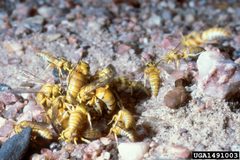
Small , estimated 8–10 mm in length. Females have that are strongly convergent at the bottom of the and strongly divergent at the top of the . The second submarginal in the forewing is or nearly so. Males below average size are black with pale white bands on the . Larger males show increasing yellow pigmentation on and lateral surfaces, with the proportion of yellow correlating positively with body size.
Habitat
Sandy substrates suitable for burrow excavation; open sandy areas, sand banks, and dunes. Nests are constructed in with multiple females nesting in close proximity.
Distribution
Found in the Caribbean Sea region, Central America, North America, and South America. Specific records include: United States, Caribbean islands, Mexico, Central America, and South American countries including Brazil (Amazonas, Goiás, Minas Gerais, Mato Grosso do Sul, Mato Grosso, Pará, Pernambuco, Piauí, Rio de Janeiro, Santa Catarina, São Paulo).
Seasonality
Active during warm periods; have been observed nesting on extremely hot days. of offspring occurs the year following nesting. Males gather in sleeping clusters early in the season; female-only clusters occur late in the season.
Diet
females hunt leafhoppers ( Cicadellidae and related families) as prey for larval provisioning. is practiced: prey is delivered to the larva on an as-needed basis rather than stockpiled. Recorded prey deliveries per nest range from 71 to 757 items.
Life Cycle
Females excavate burrows in sand, lay a single in a at the burrow terminus, and provision progressively with leafhoppers. The larva feeds and develops through instars; the burrow is sealed permanently at or before the pre-pupal stage. Offspring emerge the following year. Males may dig to reach pre-emergent virgin females.
Behavior
Females exhibit strong nest fidelity, returning repeatedly to complete burrow excavation despite disturbance. Highly gregarious nesting with multiple individuals in small areas. Males display alternative mating tactics: large males dig at areas and carry females away in to avoid harassment; small males patrol peripherally. Males are highly competitive and may physically fight over females, including attempting to dislodge coupled rivals. Both sexes form sleeping clusters on vegetation near nesting areas. Females have been observed ejecting intruding ants from burrows.
Ecological Role
of leafhoppers, potentially contributing to of these herbivorous insects. Participates in nutrient cycling through on sap-feeding insects. Serves as for nest including velvet ants (Mutillidae) and cuckoo wasps (Chrysididae).
Similar Taxa
- Bicyrtes speciesSimilar size and general appearance; distinguished by wing venation and convergence pattern in Bembecinus
- Microbembex speciesOverlapping subtribe; Bembecinus distinguished by second submarginal and
- Other Bembecinus speciesRequire examination of wing venation, structure, and male coloration patterns for definitive identification
More Details
Thermoregulation and Color
Yellow pigmentation in large males correlates with higher cuticular reflectance, hypothesized to function as a thermoregulatory allowing larger males to tolerate high temperatures and solar radiation in areas where digging occurs.
Mating System
maintains condition-dependent behavioral and morphological tactics. The largest males (~25% of ) obtain over 90% of matings in areas; size-biased mating success drives the alternative tactic system.
Nest Parasites
Unlike most burrowing , Bembecinus has no documented fly (Sarcophagidae), an unexplained exception given the ubiquity of satellite flies in other sphecoid wasps.
Sources and further reading
- BugGuide
- Wikipedia
- GBIF taxonomy match
- iNaturalist taxon
- Catalogue of Life
- Bembicid Holdings | Entomology Research Museum
- Bug Eric: Wasp Wednesday: Bembecinus
- Recycling of the shrew: Broad-headed bug, Megalotomus quinquespinosus — Bug of the Week
- Bug Eric: What's on Dat Scat?
- Archive — Bug of the Week
- Phenotypic correlates of mating success in the sand wasp Bembecinus quinquespinosus (Hymenoptera: Sphecidae)