
Psammaletes mexicanus
(Cameron, 1890)
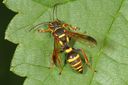
Psammaletes mexicanus is a sand wasp in the Crabronidae, Bembicinae. The was described by Cameron in 1890. It occurs in sandy across Central America and North America. As a member of the tribe Bembicini (formerly treated as family Bembicidae or Nyssonidae), it is part of a diverse lineage of solitary that provision nests with paralyzed prey.
Pronunciation
How to pronounce Psammaletes mexicanus: //ˌpsæməˈleɪtiːz mɛksɪˈkɑːnəs//
These audio files are automatically generated. While they are not always 100% accurate, they are a good starting point.
Identification
Psammaletes mexicanus can be distinguished from other Psammaletes by examination of morphological characters. The Psammaletes is characterized by features typical of the subtribe Gorytina, including adaptations for digging in sandy substrates. The species is listed in museum collections under the Bembicidae holdings, reflecting its historical classification. Precise identification requires reference to the original description (Cameron, 1890) and comparison with related species such as P. bigeloviae and P. schlingeri.
Images
Habitat
The name Psammaletes (from Greek psammos, sand) indicates an association with sandy environments. As a sand wasp, it inhabits areas with loose, sandy soils suitable for nest excavation. Specific microhabitat preferences for P. mexicanus have not been documented.
Distribution
Recorded from Central America and North America. GBIF distribution records indicate presence in Middle America and North America. The name "mexicanus" reflects its description from Mexican material, though the range extends northward into the United States.
Ecological Role
As a member of the Bembicinae, Psammaletes mexicanus likely functions as a of other insects, provisioning subterranean nests with paralyzed prey for larval development. The subtribe Gorytina to which it belongs typically preys on various insects including true bugs (Hemiptera) and other groups.
Similar Taxa
- Psammaletes bigeloviaeCongeneric with overlapping distribution in western North America; distinguished by morphological details of clypeal structure and patterns
- Psammaletes schlingeriDescribed by Bohart from California; similar sandy preferences but differs in structural features of the propodeum and male genitalia
- Bembix speciesMembers of the same tribe Bembicini with similar sand-nesting ; Bembix typically have more robust body form and different wing venation
More Details
Taxonomic History
Psammaletes mexicanus has been classified variously under Bembicidae (as Nyssonidae) and is now placed in Crabronidae, Bembicinae, following recent phylogenetic revisions of the . The UCR Entomology Research Museum lists this among their curated Bembicid holdings.