
Colletes solidaginis
Swenk, 1906
Goldenrod Cellophane Bee
Colletes solidaginis, known as the goldenrod cellophane , is a solitary ground-nesting bee in the Colletidae. Like other members of its , it constructs subterranean burrows lined with a waterproof, cellophane-like secretion from abdominal glands. The is found in North America and is associated with goldenrod (Solidago) flowers, as suggested by its specific epithet.
Pronunciation
How to pronounce Colletes solidaginis: /kəˈliːtiːz ˌsɒlɪˈdædʒɪnɪs/
These audio files are automatically generated. While they are not always 100% accurate, they are a good starting point.
Identification
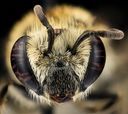
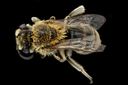
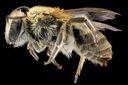
Colletes solidaginis can be distinguished from similar ground-nesting bees by the combination of its -shaped (in frontal view), forked or bifurcated mouthparts (visible when extended), and wing venation featuring three submarginal with a distinctly S-shaped (sinuous) second recurrent . Males have longer than females and lack the pollen-collecting scopa on the hind legs. -level identification within Colletes typically requires microscopic examination due to the subtle morphological differences between closely related species.
Images
Habitat
Nests in sandy soils with sparse vegetation, including bare patches in lawns, coastal sand dunes, and open grasslands. Prefers sunny locations for nesting .
Distribution
North America; recorded from the United States including Vermont.
Host Associations
- Solidago - pollen/nectar sourceAssociation inferred from specific epithet 'solidaginis'; likely oligolectic on goldenrod
Life Cycle
or . Females excavate individual burrows in spring or fall, lining with a waterproof, cellophane-like secretion from the . Each cell is provisioned with a semi-liquid mixture of nectar and pollen, sealed with an , and left for larval development. Larvae feed on provisions and pupate underground, emerging as the following season.
Behavior
Solitary but nests in dense where hundreds to thousands of females may occupy small areas. Males emerge first (protandry) and form mating swarms, pursuing females aggressively and creating mating balls. Both sexes are docile and extremely reluctant to sting. Females exhibit continuous activity at nesting sites, while males frequently land on the ground in nesting areas.
Ecological Role
Native ; contributes to pollination of early spring and late autumn flowering plants. As a ground-nesting , it provides soil aeration through burrowing activity.
Human Relevance
Beneficial with no significant negative impacts. Large nesting may cause concern to homeowners but pose no stinging threat. can be supported by maintaining bare, sandy soil patches and avoiding use.
Similar Taxa
- AndrenaMining bees share ground-nesting habit and general appearance, but have rounder in frontal view and a straight (not S-shaped) second recurrent wing
- HalictusSweat bees overlap in size and but differ in wing venation and facial structure
- LasioglossumSweat bees can appear similar but lack the forked tongue and distinctive cellophane lining of Colletes
More Details
Nesting Biology
Females produce a distinctive cellophane-like lining in using secretions from the , mixed with saliva applied using mouthparts as a trowel. This waterproof coating preserves the semi-liquid pollen-nectar provisions for developing larvae.
Conservation Notes
Nesting may persist in the same location for multiple years. Destruction of nesting sites through landscaping or application can eliminate significant local in a single season.
Sources and further reading
- BugGuide
- Wikipedia
- GBIF taxonomy match
- iNaturalist taxon
- Catalogue of Life
- An introduction to the Northern Colletes mining bee - Buglife Blog - Buglife
- Boisterous bee-havior of ground nesting bees, Colletes thoracicus — Bug of the Week
- Spring sunshine heralds the appearance of plasterer bees: Colletes — Bug of the Week
- Spring arrives and with it, delightful Plasterer bees: Colletes spp. — Bug of the Week
- Spring sunshine heralds the appearance of plasterer bees, Colletes — Bug of the Week
- Bug Eric: Polyester Bees