
Colletes slevini
Cockerell, 1925
Slevin's cellophane bee, Slevin's polyester bee
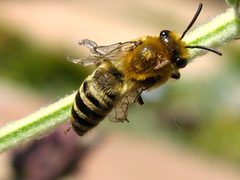
Colletes slevini, commonly known as Slevin's cellophane or Slevin's polyester bee, is a solitary ground-nesting bee in the Colletidae. As a member of the Colletes, it shares the characteristic of lining its underground with a cellophane-like secretion produced from the . The is found in North America, though specific details about its range and remain limited in published sources. Like other Colletes species, it is a native that emerges in spring.
Pronunciation
How to pronounce Colletes slevini: //ˈkɒl.ɪ.tiːz ˈslɛv.ɪ.naɪ//
These audio files are automatically generated. While they are not always 100% accurate, they are a good starting point.
Identification
Identification of C. slevini requires microscopic examination. Members of the Colletes can be distinguished from similar mining bees (Andrena) and sweat bees (Halictus, Lasioglossum) by: a forked or bifurcated (tongue) when extended; a -shaped in frontal view (round in Andrena); and an S-shaped second recurrent in the forewing (straight in Andrena). Males have longer than females and lack the scopa (pollen-collecting hairs) on the hind legs. -level identification within Colletes is difficult and typically requires examination of subtle morphological characters.
Images
Distribution
North America. Specific range details beyond this continental-level distribution are not documented in available sources.
Ecological Role
As a member of the Colletes, this functions as a native solitary . Based on genus-level characteristics, females are ground-nesting and likely contribute to pollination of spring-blooming plants.
Human Relevance
Similar Taxa
- Colletes inaequalisSympatric spring-flying plasterer bee with similar nesting and appearance; microscopic examination required for separation.
- Andrena spp.Mining bees that share ground-nesting habit and general appearance; distinguished by round and straight second recurrent in forewing.
- Halictus spp.Sweat bees that overlap in size and ; distinguished by wing venation and mouthpart structure.
Sources and further reading
- BugGuide
- Wikipedia
- GBIF taxonomy match
- iNaturalist taxon
- Catalogue of Life
- An introduction to the Northern Colletes mining bee - Buglife Blog - Buglife
- Boisterous bee-havior of ground nesting bees, Colletes thoracicus — Bug of the Week
- Spring sunshine heralds the appearance of plasterer bees: Colletes — Bug of the Week
- Spring arrives and with it, delightful Plasterer bees: Colletes spp. — Bug of the Week
- Spring sunshine heralds the appearance of plasterer bees, Colletes — Bug of the Week
- Bug Eric: Polyester Bees