
Colletes kincaidii
Cockerell, 1898
Kincaid's Cellophane Bee, Kincaid's Polyester Bee
Colletes kincaidii, known as Kincaid's cellophane , is a solitary ground-nesting bee in the Colletidae. Like other Colletes , females construct individual burrows and line with a cellophane-like secretion from the , creating waterproof chambers for larval development. The species has been documented as a for the cleptoparasitic bee Epeolus compactus, which exploits its nests. It is found in North America, with confirmed records from Vermont.
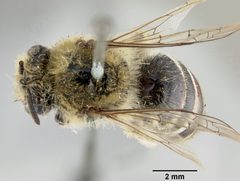
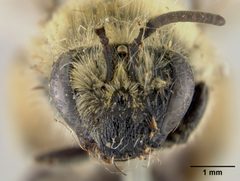
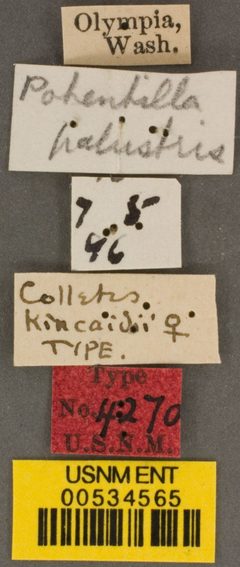
Pronunciation
How to pronounce Colletes kincaidii: /kəˈliːtiːz kɪnˈkeɪdiːaɪ/
These audio files are automatically generated. While they are not always 100% accurate, they are a good starting point.
Images
Habitat
Sandy or well-drained soils with sparse vegetation, including bare patches in lawns and open ground. Nests in where multiple females excavate burrows in close proximity.
Distribution
North America; confirmed present in Vermont, United States.
Host Associations
- Epeolus compactus - Epeolus compactus is a known that exploits nests of Colletes kincaidii, laying in to usurp pollen and nectar provisions.
Life Cycle
Females construct subterranean galleries with individual lined with a translucent, cellophane-like coating secreted from the . Larvae develop within these waterproofed chambers, feeding on provisions of nectar and pollen. forms undergo development in the nest, with timing likely varying by region.
Behavior
Solitary but nests in , with many females occupying small areas. Females excavate individual burrows and apply abdominal secretions to line . Males patrol nesting areas seeking mates.
Ecological Role
Native ; contributes to pollination of flowering plants. Serves as for cleptoparasitic bees, supporting higher in .
Human Relevance
Non-aggressive and reluctant to sting; poses minimal threat to humans. Nesting may cause concern to homeowners but are beneficial for pollination. vulnerable to loss and application.
Similar Taxa
- Colletes inaequalisSympatric vernal Colletes with similar ground-nesting and appearance; microscopic examination often required for definitive separation.
- Colletes thoracicusAnother vernal plasterer bee with overlapping range and similar nesting habits; difficult to distinguish without detailed morphological examination.
- Andrena speciesMining bees in Andrenidae share ground-nesting habits and general appearance; distinguished by rounder shape and straight second recurrent wing versus sinuous vein in Colletes.
Sources and further reading
- BugGuide
- Wikipedia
- GBIF taxonomy match
- iNaturalist taxon
- NCBI Taxonomy
- Catalogue of Life
- An introduction to the Northern Colletes mining bee - Buglife Blog - Buglife
- Boisterous bee-havior of ground nesting bees, Colletes thoracicus — Bug of the Week
- Spring sunshine heralds the appearance of plasterer bees: Colletes — Bug of the Week
- Spring arrives and with it, delightful Plasterer bees: Colletes spp. — Bug of the Week
- Spring sunshine heralds the appearance of plasterer bees, Colletes — Bug of the Week
- Bug Eric: Polyester Bees
- The Nesting Biology of Colletes kincaidii Cockerell (Hymenoptera: Colletidae) and Development of Its Immature Forms
- Comparative Notes on the Biology and Development of Epeolus compactus Cresson, a Cleptoparasite of Colletes kincaidii Cockerell (Hymenoptera: Anthophoridae, Colletidae)