
Philotrypesis
Förster, 1878
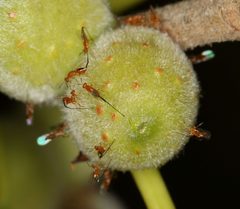
Philotrypesis is a of parasitic in the Pteromalidae. These small chalcidoid wasps are primarily associated with fig trees (Ficus) as of fig wasps. The genus has been recorded from multiple regions including Hawaii and Japan, with 266 observations documented on iNaturalist. Taxonomic placement has varied historically, with some sources formerly placing it in Agaonidae, though current consensus places it in Pteromalidae.
Pronunciation
How to pronounce Philotrypesis: /ˌfɪloʊˈtraɪpəsɪs/
These audio files are automatically generated. While they are not always 100% accurate, they are a good starting point.
Identification
Philotrypesis are small chalcidoid wasps, generally under 5 mm in length. They possess the reduced wing venation characteristic of the superfamily Chalcidoidea, with forewings lacking closed beyond the basal fold. Within Pteromalidae, they may be distinguished from related by features of the and mesosoma, though species-level identification requires detailed examination. The genus is most readily recognized by its association with fig syconia and its parasitic lifestyle relative to other fig-associated .
Images
Habitat
Primarily associated with fig trees (Ficus ), where they inhabit the syconia (enclosed inflorescences). The develop inside fig fruits, making their intrinsically linked to the distribution and of their figs. They occur in both native and introduced fig .
Distribution
Recorded from Hawaii and Japan based on GBIF distribution data. The likely has a broader distribution coinciding with Ficus plants in tropical and subtropical regions. The 266 iNaturalist observations suggest established in areas where figs are present.
Seasonality
Activity patterns are tied to the of fig trees, as must coincide with receptive fig syconia. Specific seasonal timing varies by region and fig .
Host Associations
- Ficus - Develops inside fig syconia
- fig wasps (Agaonidae) - of pollinating and non-pollinating larvae
Life Cycle
Development occurs entirely within fig syconia. Females oviposit into larvae or pupae inside the fig cavity. Larvae develop as , feeding on tissues, before pupating and emerging as through the fig . The is synchronized with the development of both the fig fruit and its associated .
Behavior
are short-lived and primarily focused on locating receptive fig syconia and for oviposition. Females enter fig syconia to access hosts, navigating the narrow . Mating typically occurs within or immediately outside the natal fig.
Ecological Role
Acts as a within , contributing to of pollinating and non-pollinating fig wasp . This is part of the complex trophic web associated with fig trees, which support diverse communities of .
Human Relevance
No direct economic importance. Indirectly relevant to understanding fig pollination and the maintenance of fig tree , which have cultural and ecological significance in many regions. Some fig are economically important for fruit production.
Similar Taxa
- SycoryctesAlso a pteromalid associated with fig syconia as ; separation requires examination of antennal structure and ovipositor
- SycoscapterAnother fig-associated pteromalid ; distinguished by differences in mesosomal and wing proportions
More Details
Taxonomic History
Philotrypesis has been placed in different by various authorities. GBIF records indicate Agaonidae in some taxonomic treatments, while Catalogue of Life, NCBI, and iNaturalist place it in Pteromalidae. This reflects historical uncertainty in the classification of fig-associated non-pollinating . Current consensus favors Pteromalidae ( Pteromalinae, tribe Otitesellini).
Fig Wasp Community Context
Philotrypesis is one of numerous that exploit fig syconia. Fig trees typically one pollinating agaonid plus multiple non-pollinating wasps including (like Philotrypesis), gall-makers, and . The genus contributes to the high characteristic of fig-wasp .