
Perilampus auratus
(Panzer, 1798)
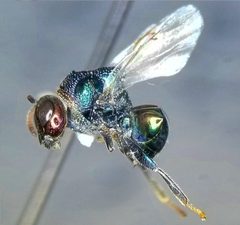
Perilampus auratus is a minute parasitic wasp in the Perilampidae (Hymenoptera: Chalcidoidea), measuring 1.3–5.5 millimeters in length. The exhibits brilliant metallic coloration typical of the . As a member of Perilampidae, it is a hyperparasitoid, with larvae that parasitize other parasitic insects. New country records have been documented in Romania and Turkey, expanding its known Palaearctic distribution.
Pronunciation
How to pronounce Perilampus auratus: /ˌpɛrɪˈlæmpəs ɔːˈreɪtəs/
These audio files are automatically generated. While they are not always 100% accurate, they are a good starting point.
Identification
Distinguished from similar small metallic , particularly cuckoo wasps (Chrysididae), by the triangular with sharp corners—cuckoo wasps have oval or rounded abdomens. The short, strongly elbowed also aid recognition. Identification to level requires examination of specific morphological characters detailed in taxonomic keys.
Images
Appearance
Small, compact with brilliant metallic green, blue, or gold coloration typical of many perilampids. Body length ranges 1.3–5.5 mm. short and strongly elbowed. triangular or inverted pyramid-shaped, with distinct corners (not rounded).
Distribution
Europe (Palaearctic region); recorded from Germany, Italy, Sweden, Romania (new record), and Turkey (new record).
Life Cycle
As a perilampid, likely exhibits the -characteristic hyperparasitic : females broadcast on vegetation or other surfaces; larvae hatch and attach to moving ; larvae penetrate secondary host to locate primary host; development completes as external of primary host pupa. Specific details for P. auratus unconfirmed.
Ecological Role
Hyperparasitoid—larvae parasitize other parasitic insects, potentially regulating of primary such as tachinid flies, ichneumon wasps, or braconid wasps.
Similar Taxa
- Chrysididae (cuckoo wasps)Similar small size and metallic coloration; distinguished by rounded or oval lacking sharp corners, and different structure.
- Other Perilampus speciesRequire detailed morphological examination; European can be separated using diagnostic keys based on specific structural characters.
More Details
Taxonomic status
validity confirmed; new faunistic records published in 2022 expanded known distribution to Romania and Turkey.
Research needs
associations and complete details remain undocumented for this specifically; inferred from -level studies.
Sources and further reading
- BugGuide
- GBIF taxonomy match
- iNaturalist taxon
- Catalogue of Life
- Bug Eric: Wasp Wednesday: Pseudomalus auratus
- Bug Eric: Wasp Wednesday: Perilampid Wasps
- Bane of dogbane, the beautiful and the ugly: Dogbane leaf beetle, Chrysochus auaratus, and dogbane webworm, Saucrobotys futilalis — Bug of the Week
- Guest Blogger: Dogbane for Dinner | Beetles In The Bush
- Hooray for the red, white, and blue! Milkweed longhorned beetle, Tetraopes tetraophthalmus; dogbane tiger moth, Cycnia tenera; and familiar bluet, Enallagma civile — Bug of the Week
- Bug Eric: June 2024
- Perilampus neglectus and other neglected species: new records of Palaearctic Perilampidae (Hymenoptera, Chalcidoidea), with a key to European species of Perilampus