
Elachertus
Spinola, 1811
Species Guides
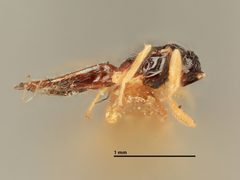
3Elachertus is a of small in the Eulophidae. within this genus are primarily larval ectoparasitoids of Lepidoptera, with documented associations on including tortricid, geometrid, syntomid, and gelechiid moths. Several species have been studied for their potential in of forest and agricultural pests. The genus exhibits variation in strategies, with most species being idiobiont ectoparasitoids, though at least one species (E. scutellatus) has been reported as koinobiont.


Pronunciation
How to pronounce Elachertus: /ɛˈlæʃɚtəs/
These audio files are automatically generated. While they are not always 100% accurate, they are a good starting point.
Images
Habitat
Associated with supporting their lepidopteran , including coniferous forests (spruce-fir stands), deciduous forests, fruit orchards, and banana plantations. Specific habitat requirements vary by host association.
Distribution
Documented from North America (including Canada and the southeastern United States), Europe, and Asia (China: Fujian). GBIF records indicate presence in the Canary Islands, Florida, Georgia, Louisiana, and Fujian Province.
Host Associations
- Choristoneura fumiferana - primary spruce budworm (Tortricidae); primary of E. cacoeciae in North America
- Laspeyresia strobilella - primary pine cone pest; of E. geniculatus in Europe
- Ceramidia butleri - primary banana pest (Syntomidae); of E. ceramidiae
- Tuta absoluta - primary tomato leafminer (Gelechiidae); of two Elachertus
- Glena bisulca - primary geometrid in Colombia
- Melanolophia commo-taria - primary geometrid in Colombia
Life Cycle
Development from to approximately 20 days at 20.6°C in E. cacoeciae. Pre-oviposition period of 11.5 days reported for spring females of E. cacoeciae, with time (egg to egg) of approximately 31 days. Oviposition period lasts 76 days with lifetime of approximately 97 eggs. Larval development of Colombian Elachertus sp. takes about 9 days, with eggs hatching 3 days after oviposition. occurs primarily as pupae; in E. cacoeciae, approximately 95% of pupae from summer females overwinter versus 2% from spring females.
Behavior
Gregarious ectoparasitoid, with multiple individuals developing on a single . Exhibits host-size dependent oviposition , with preference for intermediate-sized host larvae (fifth instar in spruce budworm). Host feeding occurs without oviposition on additional hosts. Sex ratio varies seasonally, with proportion of females increasing through the season. Competes with other for shared host resources, including negative -dependent interactions with Tranosema rostrale.
Ecological Role
Larval ectoparasitoid of Lepidoptera, contributing to top-down of . Acts as agent for several forestry and agricultural pests. Hyperparasitism has been documented, with approximately 40% mortality of Elachertus reported in Colombia due to hyperparasite attack.
Human Relevance
Investigated and utilized as agent for spruce budworm (Choristoneura fumiferana), a major defoliator of North American forests. Potential for control of Tuta absoluta (tomato leafminer), an important agricultural pest. Documented as of conifer seed pest Laspeyresia strobilella in Europe.
Similar Taxa
- Tranosema rostraleBoth are of spruce budworm; E. cacoeciae is idiobiont ectoparasitoid while T. rostrale is koinobiont endoparasitoid; direct competition occurs between these
- Other Eulophidae generaElachertus can be distinguished by combination of morphological features detailed in taxonomic keys for Nearctic eulophid
Sources and further reading
- BugGuide
- Wikipedia
- GBIF taxonomy match
- iNaturalist taxon
- NCBI Taxonomy
- Catalogue of Life
- Elachertus Sp. (Hymonoptera: Eulophidae) Nuevo Parasito de Importancia Forestal En Colombia
- Two species of the genus Elachertus Spinola (Hym.: Eulophidae) new larval ectoparasitoids of Tuta absoluta (Meyreck) (Lep.: Gelechidae)
- Density‐dependence and competition between Tranosema rostrale and Elachertus cacoeciae, two parasitoids of the spruce budworm
- On the biology and taxonomy of some European species of the genus Elachertus Spinola (Hymenoptera, Eulophidae)
- Studies on the Biology of Elachertus ceramidiae (Hymenoptera: Eulophidae), a Parasite of the Banana Pest Ceramidia butleri (Lepidoptera: Syntomidae)1
- Unusual Life History Characteristics of <I>Elachertus scutellatus</I> Howard (Hymenoptera: Eulophidae), a Koinobionic Ectoparasitoid
- LIFE HISTORY CHARACTERISTICS OF ELACHERTUS CACOECIAE (HYMENOPTERA: EULOPHIDAE), AN ECTOPARASITOID OF SPRUCE BUDWOR LARVAE, CHORISTONEURA FUMIFERANA (LEPIDOPTERA: TORTRICIDAE)
- Influence of host size on oviposition behaviour and fitness of Elachertus cacoeciae attacking a low‐density population of spruce budworm Choristoneura fumiferana larvae