
Euderus
Haliday, 1844
Species Guides
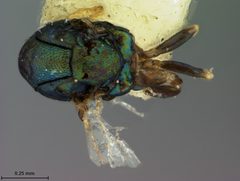
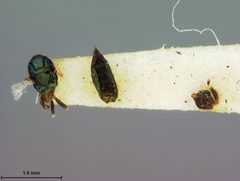
1Euderus is a of chalcid wasps in the Eulophidae, comprising approximately 77 with distribution. The genus is notable for including species that manipulate , most prominently E. set, the "crypt-keeper ," which induces gall wasps to create -plugged exit holes that facilitate parasitoid . In North America alone, the genus contains 25 species arranged in five subgenera. Species exhibit striking metallic coloration ranging from olive green to turquoise to iridescent blue.

Pronunciation
How to pronounce Euderus: //juːˈdɛrəs//
These audio files are automatically generated. While they are not always 100% accurate, they are a good starting point.
Identification
Euderus are extremely small, typically measuring 1–3 mm in length. They display characteristic metallic coloration—shiny olive green, turquoise, or iridescent blue depending on lighting, age, and species. The is distinguished from related eulophid genera by antennal structure and wing venation patterns; keys to subgenera and species exist for regional faunas. North American species are classified into five subgenera: Secodelloidea, Euderus (sensu stricto), Euderoides, Neoeuderus, and Leipocrossus, distinguished by morphological characters.
Images
Habitat
are defined by availability rather than fixed environmental parameters. are found in association with oak forests (where gall wasp hosts occur), agricultural systems including sweetpotato , and areas with stem-galling weevils on leguminous plants. The crypt-keeper E. set inhabits live oak systems in the southeastern United States.
Distribution
distribution with records from North America (including Canada, United States, and Mexico), India (Uttarakhand, Kerala, Madhya Pradesh), British Columbia, California, and the Canary Islands. In North America, 25 are recognized. E. set is known from the U.S. Gulf Coast (Florida, Georgia, Mississippi, Louisiana, Texas).
Host Associations
- Bassettia pallida - of E. set; gall wasp manipulated to create -plugged exit holeprimary for behavioral manipulation study
- Alcidodes bubo - of E. pantnagarensis; shoot weevil inducing stem gallsColeoptera: Curculionidae on Sesbania bispinosa
- Cylas formicarius elegantulus - of E. purpureas; sweetpotato weevilColeoptera: Apionidae; agricultural pest in southern Florida
- Additional gall wasp species - of E. setat least six additional oak gall wasp from taxonomically diverse lineages are attacked and behaviorally manipulated
Behavior
E. set exhibits a remarkable form of manipulation: the induces gall wasp hosts to chew an incomplete exit hole in their larval chamber and plug it with their . The parasitoid then emerges through the host's head capsule, leaving exoskeletal remains in the 'crypt.' This manipulation has been observed across at least seven gall wasp host . The provides a benefit to the parasitoid by facilitating escape from the enclosed gall chamber.
Ecological Role
of gall-forming and stem-boring insects, primarily weevils and gall wasps. E. set functions as a behavioral manipulator in oak gall wasp . Some serve as agents of agricultural pests, including sweetpotato weevil.
Human Relevance
Potential and documented use in of agricultural pests. E. purpureas parasitizes sweetpotato weevil, a significant crop pest. The has contributed to scientific understanding of manipulation by , with E. set serving as a model system for studying extended phenotypes and the evolution of behavioral control.
Similar Taxa
- Other Eulophidae generaEuderus is distinguished by specific antennal and wing venation characters; requires microscopic examination and use of taxonomic keys for separation
- Other chalcid wasp familiesEulophidae are recognized by reduced wing venation with characteristic linear or curved setae on the ; Euderus further distinguished by metallic coloration and small size
More Details
Subgeneric classification
North American Euderus comprises five subgenera: Secodelloidea Girault, Euderus Haliday (sensu stricto), Euderoides (new subgenus), Neoeuderus (new subgenus), and Leipocrossus (new subgenus). Two natural groups (albitarsis and solidaginis) are recognized within Euderus s. str.
Taxonomic history
The was established by Haliday in 1844. A major revision for America north of Mexico described 13 new and reorganized the genus into its current subgeneric structure.
Sources and further reading
- BugGuide
- Wikipedia
- GBIF taxonomy match
- iNaturalist taxon
- NCBI Taxonomy
- Catalogue of Life
- Zookeys | Blog - Part 28
- Euderus purpureas (Hymenoptera: Eulophidae): A Parasitoid of Sweetpotato Weevil (Coleoptera: Apionidae) in Southern Florida
- REVISION OF THE GENUSEUDERUSOF AMERICA NORTH OF MEXICO (HYMENOPTERA: EULOPHIDAE)
- A New Species of Parasitoid Wasp Euderus (Eulophidae: Chalcidoidea: Hymenoptera) from Uttarakhand, India on Dainha Shoot Weevil
- A keeper of many crypts: the parasitoid Euderus set manipulates the behavior of a taxonomically diverse array of oak gall wasp species