
Brachymeria ovata
(Say, 1824)
Brachymeria ovata is a small parasitic wasp in the Chalcididae, first described by Thomas Say in 1824. The Brachymeria contains 26 known in North America, all characterized by heavily armored bodies and enlarged hind adapted for jumping. These 3-6 mm are primary or secondary of Lepidoptera and muscoid fly larvae, emerging from pupae. The species has been recorded from Ohio, Pennsylvania, and Canada.
Pronunciation
How to pronounce Brachymeria ovata: /brəˌkaɪˈmɛriə oʊˈveɪtə/
These audio files are automatically generated. While they are not always 100% accurate, they are a good starting point.
Identification
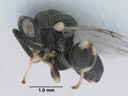
The Brachymeria is recognized by the distinctive hind leg : greatly swollen and bowed tibiae that fit the curvature of the femur. -level identification within Brachymeria requires examination of minute morphological characters not reliably visible in field observations. B. ovata specifically may be distinguished from by subtle structural features of the , wing venation, and body proportions, though these require microscopic examination and comparison with reference specimens.
Images
Habitat
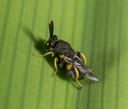
have been observed in diverse environments including near colonies where they feed on honeydew, and in shaded vegetation such as cattails and cottonwood leaves near wetlands. The likely occurs in open woodlands, forest edges, meadows, and anthropogenic where insects are abundant.
Distribution
Recorded from Ohio, Pennsylvania, and Canada. The Brachymeria is widespread in North America. Distribution likely broader than current records suggest, given under-sampling of small parasitic .
Seasonality
activity period not specifically documented for B. ovata. Related Brachymeria are active during warmer months when insects are available. The from to adult in takes approximately 20-27 days under favorable conditions, with requiring 155-180 days.
Diet
feed on honeydew secreted by aphids and occasionally visit flowers such as wild carrot (Daucus carota). Larvae are , developing inside larvae.
Host Associations
- Lepidoptera larvae - primary or secondary larvae are parasitized; emerge from host pupae
- Muscoid flies - primary or secondary Includes blow flies and flesh flies
Life Cycle
Females use their ovipositor to inject into larvae. Multiple eggs may be deposited in a single host, but typically only one larval offspring matures and emerges from the host pupa. Development from egg hatching to requires approximately 20-27 days under favorable conditions; extend to 155-180 days. The overwinters in the pupal stage within the host .
Behavior
exhibit a characteristic 'play possum' defense : when disturbed, an individual may hug its legs to its body and remain motionless. They are capable of rapid jumping escape using modified hind legs. Adults seek shade during heat of day, often aggregating in shaded vegetation.
Ecological Role
Primary or secondary regulating of Lepidoptera and muscoid flies. May be important in limiting numbers of blow flies and flesh flies that infest small animal carcasses, and in regulating pest caterpillars. As a secondary parasitoid, may also impact populations of other parasitic .
Human Relevance
Potential agent for pest flies and caterpillars. No direct negative impacts on humans; too small to sting noticeably. may be observed by entomologists and naturalists but generally overlooked due to minute size.
Similar Taxa
- Other Brachymeria speciesAll 26 North American share the diagnostic enlarged hind and compact armored body. Microscopic examination required for species-level identification.
- Other Chalcididae genera members share 'chalcid' with modified hind legs, though femoral enlargement is most pronounced in Brachymeria. Wing venation and antennal structure differ among .
More Details
Taxonomic history
Described by Thomas Say in 1824, one of the earliest American entomologists. The Brachymeria was established by Westwood in 1829.
Research significance
The Brachymeria fonscolombei has been studied as a agent for blow flies. data cited here derives primarily from studies of this related , suggesting similar for B. ovata.
Sources and further reading
- BugGuide
- GBIF taxonomy match
- iNaturalist taxon
- Catalogue of Life
- Is Jade Lucky? Well, Bumble Bees Like It! | Bug Squad
- Bug Eric: Candystripe Spider
- Two new species of wart sea slugs discovered from Indonesia
- Bug Eric: June 2011
- Flatfaced longhorn: Leptostylus transversus | Beetles In The Bush
- These are a few of my favorite trees | Beetles In The Bush