
Blastophaga psenes
(Linnaeus, 1758)
Common Fig Wasp
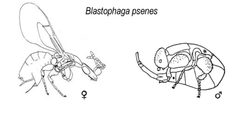
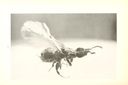
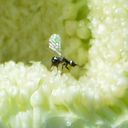
Blastophaga psenes is a minute chalcidoid , approximately 2 mm in length, and the obligate of Ficus carica (common fig) and Ficus palmata. Females are winged, black, and shiny; males are smaller, wingless, and do not disperse from the fig. The exhibits extreme and a highly specialized mutualistic relationship with its figs. live only a few days to weeks, breeding exclusively within fig syconia without constructing nests or colonies. The species is native to the Palaearctic region and has been introduced globally to support commercial fig .
Pronunciation
How to pronounce Blastophaga psenes: //ˌblæstɵˈfæɡə ˈsiːnɛs//
These audio files are automatically generated. While they are not always 100% accurate, they are a good starting point.
Identification
Distinguished from other fig wasps by specificity to Ficus carica and Ficus palmata. Females are recognized by their minute size (~2 mm), black shiny bodies, and extremely thin transparent wings that detach upon entering fig syconia. Males are wingless and smaller, emerging before females within the syconium. Presence of female wings at fig is diagnostic. Distinguished from closely related Wiebesia by host fig association and subtle morphological characters. Non-pollinating fig wasps such as Philotrypesis caricae can be distinguished by oviposition (external vs. internal to florets) and lack of pollen transport.
Images
Habitat
Strictly associated with fig syconia of Ficus carica and Ficus palmata. Breeds within the enclosed inflorescence (syconium) of male caprifigs. No external nest construction; entire occurs within figs. Availability of receptive syconia in appropriate phenological stage (receptive phase emitting pentane) is critical for suitability.
Distribution
Native to the Palaearctic region, particularly Southern Europe and the Mediterranean Basin. Widely introduced globally to regions where Ficus carica is cultivated commercially, including California and Tunisia. Distribution is constrained by presence of fig .
Seasonality
Activity synchronized with fig . peaks in spring when spring caprifigs are abundant; winter caprifigs support smaller populations due to reduced resources. Females typically produce three annually, corresponding to seasonal caprifig crops. timed to coincide with male fig flower pollen release.
Diet
Larvae feed on hyperplastic floret tissue produced by the mother during oviposition. do not feed; brief adult lifespan (days to weeks) supported by larval reserves.
Host Associations
- Ficus carica - obligate mutualistPrimary ; common fig. pollinate female flowers while breeding in male flowers.
- Ficus palmata - obligate mutualistSecondary ; closely related to F. carica.
Life Cycle
laid in female flowers of syconium. Larvae develop within fig ovaries, inducing gall formation. occurs within galls. emerge when male fig flowers release pollen. Males emerge first, search for females, and mate within syconium; males then enlarge fig opening and die. Females emerge, collect pollen, and disperse to locate new receptive syconia. Entire cycle completed within single syconium ; no overlapping generations within same fig.
Behavior
Females locate receptive figs using olfaction, specifically detecting pentane emitted by figs in receptive phase from at least 5 meters away. Upon locating a fig, females assess suitability by antennal contact with the before entry. Wings and detach during entry through narrow ostiole. Females exhibit rush upon , competing to enter adjacent syconia. Males exhibit precocious emergence and mate-searching behavior; some mating occurs before females fully emerge from cocoons. Males enlarge exit holes to facilitate female dispersal.
Ecological Role
Obligate of Ficus carica and F. palmata; mutualism is -specific and essential for fig . Serves as for Schistonchus caprifici and bacterial associate Serratia ficaria. Prey for ants that use fig odor cues to locate . for fungal Fusarium moniliforme (fig endosepsis).
Human Relevance
Essential for commercial fig production; global introductions to support Ficus carica . Documented as potential trigger of anaphylaxis in mastocytosis patients, with antigens present in female figs. Source of bacterial Serratia ficaria. Subject of entomological research on mutualism, , and fig- specificity.
Similar Taxa
- Wiebesia spp.Closely related that also pollinates Ficus ; distinguished by fig associations and subtle morphological differences.
- Philotrypesis caricaeNon-pollinating associated with same fig ; distinguished by external oviposition, lack of pollen transport, and potential kleptoparasitic relationship.
More Details
Sexual dimorphism and dispersal
Only females disperse between figs; males are wingless, never leave the natal syconium, and die shortly after mating and enlarging the exit hole.
Olfactory host location
Specific chemoattraction to pentane allows females to distinguish F. carica from other fig and identify receptive-phase syconia.
Dioecy and reproductive strategy
Male fig trees (caprifigs) support ; female fig trees produce edible fruit but are lethal to wasps due to long styles preventing oviposition. This in fig trees maintains the mutualism.
Parasite and pathogen associations
Efficient for Schistonchus caprifici; fungus Fusarium moniliforme causing fig endosepsis; contaminated by fungus upon through .
Sources and further reading
- BugGuide
- Wikipedia
- GBIF taxonomy match
- iNaturalist taxon
- NCBI Taxonomy
- Catalogue of Life
- Wasps, Wasps, Wasps: Weird and Wonderful Wasps | Bug Squad
- Mastocytosis and the Fig Wasp (<b><i>Blastophaga psenes</i></b>)
- Serratia ficaria sp. nov., a bacterial species associated with Smyrna figs and the fig waspBlastophaga psenes