
Blastophaga
Gravenhorst, 1829
fig wasps
Species Guides
1- Blastophaga psenes(Common Fig Wasp)
Blastophaga is a of minute in the Agaonidae that engage in obligate mutualism with Ficus fig trees, a coevolutionary relationship spanning at least 80 million years. Female wasps enter receptive figs (syconia) through specialized to lay in flowers and transport pollen, enabling fig . The genus exhibits varying degrees of specificity, with some showing strict fidelity to particular Ficus species while others demonstrate host sharing across multiple varieties. Notable species include Blastophaga psenes, the exclusive of the common fig (Ficus carica), and Blastophaga javana, associated with Ficus hirta.
Pronunciation
How to pronounce Blastophaga: //ˌblæstoʊˈfæɡə//
These audio files are automatically generated. While they are not always 100% accurate, they are a good starting point.
Identification
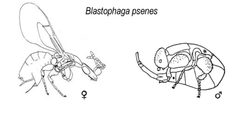
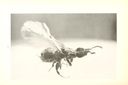
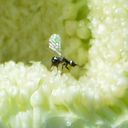
Extremely small , typically under 2 mm in length. Females possess specialized morphological adaptations for fig entry, including flattened and elongated ovipositors for reaching flowers within the enclosed syconium. Males are wingless with reduced and non-functional mouthparts; they remain within the fig to mate with females and create exit tunnels. Distinguished from non-pollinating fig wasps (Sycophaginae, Otitesellinae) by pollen-carrying structures and active pollination .
Images
Habitat
Tropical and subtropical regions worldwide; strictly associated with Ficus fig trees. Found within enclosed fig inflorescences (syconia) during development; briefly active outside figs during phases.
Distribution
Pantropical distribution with records from Southeast Asia, Mediterranean region, Japan, Rica, and other tropical and subtropical zones. Specific distributions correlate with Ficus ranges: B. psenes occurs with cultivated Ficus carica; B. javana in Southeast Asia with Ficus hirta; B. quadraticeps with Ficus religiosa in South and Southeast Asia.
Host Associations
- Ficus carica - Blastophaga psenes is the exclusive ; cultivated common fig
- Ficus deltoidea - Multiple Blastophaga ; sharing documented across varieties
- Ficus hirta - Pollinated by Blastophaga javana
- Ficus religiosa - Pollinated by Blastophaga quadraticeps
Life Cycle
Foundress females enter receptive figs through the , losing wings and in the process. are laid in some flowers, with others receiving pollen (pollination). Larvae develop within galls formed by plant tissue response to oviposition. Males emerge first, wingless, and locate female galls; they perforate gall walls to access females for mating and chew exit tunnels through the fig wall. Females emerge, collect pollen into specialized pockets, and exit through the tunnels to seek new receptive figs.
Behavior
Female entry into figs is chemically mediated, with attracted to specific volatile compounds released by receptive syconia. Males and females exhibit differential behavioral responses to internal fig atmosphere: high CO₂ and ethylene levels in early male phase activate males for gall perforation and mating while inactivating females; equilibration with external atmosphere after wall perforation inhibits males and activates females for pollen collection and . sharing has been documented in some , challenging assumptions of strict one-to-one species specificity.
Ecological Role
Obligate of Ficus ; the mutualism is foundational to tropical function. Figs serve as critical keystone resources for diverse vertebrate (frugivorous birds, bats, primates), making these indirectly essential for maintaining rainforest biodiversity.
Human Relevance
Blastophaga psenes enables commercial production of common figs (Ficus carica), though some cultivated varieties are parthenocarpic and -independent. Fig wasps occasionally trigger allergic reactions; Blastophaga psenes allergens have been implicated in anaphylaxis in sensitized individuals, particularly those with mastocytosis or Hymenoptera venom allergy. Wasps may be present in dried figs.
Similar Taxa
- CeratosolenOther agaonid ; distinguished by Ficus subgenus associations and morphological differences in structure and ovipositor
- SycophagaNon-pollinating in Sycophaginae; lacks pollen-carrying structures and does not actively pollinate
- WiebesiaAgaonid ; overlaps in range with some Blastophaga on Ficus subgenus Ficus
Sources and further reading
- BugGuide
- Wikipedia
- GBIF taxonomy match
- iNaturalist taxon
- NCBI Taxonomy
- Catalogue of Life
- Wasps, Wasps, Wasps: Weird and Wonderful Wasps | Bug Squad
- Super Crop Challenge #10 | Beetles In The Bush
- POLLINATION PATTERNS IN Ficus deltoidea: BEHAVIOURAL INSIGHTS INTO Blastophaga sp. ENTRY AND INTERACTIONS
- Unravelling mutualistic dynamics: host specificity in Ficus deltoidea and Blastophaga sp. fig wasps
- Unraveling Mutualistic Dynamics: Host Specificity and Gene Flow in Ficus deltoidea and Blastophaga sp. Fig Wasps
- CARBON DIOXIDE AND ETHYLENE EFFECTS IN THE CO‐ORDINATION BETWEEN THE POLLINATOR BLASTOPHAGA QUADRATICEPS AND THE SYCONIUM IN FICUS RELIGIOSA
- Development of microsatellite loci for Blastophaga javana (Agaonidae), the pollinating wasp of Ficus hirta (Moraceae)
- Mastocytosis and the Fig Wasp (<b><i>Blastophaga psenes</i></b>)