
Phylloecus
Newman, 1838
Species Guides
3- Phylloecus cowichanus
- Phylloecus riesi
- Phylloecus trimaculatus(Rose Shoot Sawfly)
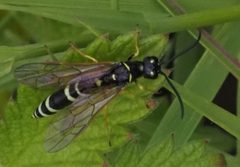
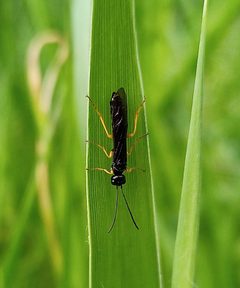
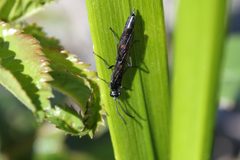
Phylloecus is a of stem sawflies in the Cephidae, first described by Edward Newman in 1838. The genus was reclassified in 2014 when Hartigia was synonymized with Phylloecus. Members of this genus are distributed across the Holarctic region, with recorded from Europe, Asia, and North America. The genus contains approximately 30 described species.
Pronunciation
How to pronounce Phylloecus: //ˈfɪloʊ.iːkəs//
These audio files are automatically generated. While they are not always 100% accurate, they are a good starting point.
Identification
Phylloecus can be distinguished from other Cephidae by a combination of morphological features, though specific diagnostic characters vary among species. The synonymy with Hartigia was established based on phylogenetic and morphological analyses showing the two names represented the same lineage. Species-level identification requires examination of detailed morphological characters such as coloration patterns, wing venation, and genitalia structure.
Images
Distribution
Recorded from Denmark, Norway, and Sweden; broader distribution includes Europe, Asia (including China, Japan, Korea, Russia), and North America (United States, Mexico, Canada).
Similar Taxa
More Details
Taxonomic history
The Hartigia, described by Schiødte in 1839, was widely used in literature for many now placed in Phylloecus. The 2014 reclassification established Phylloecus as the valid name based on priority.