
Aproceros leucopoda
Takeuchi, 1939
elm zigzag sawfly
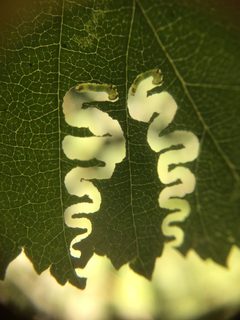
Aproceros leucopoda, commonly known as the elm zigzag , is a small sawfly native to eastern Asia (China and Japan) that has become an pest in Europe since 2003 and North America since 2020. The derives its from the distinctive zigzag-shaped feeding pattern created by young larvae on elm leaves. are entirely female and reproduce through , enabling rapid establishment from single individuals. The species can cause severe defoliation of elm trees and has recently been documented feeding on Japanese zelkova.

Pronunciation
How to pronounce Aproceros leucopoda: //ˌæ.prəˈsiː.rɒs luːˈkɒp.ɔː.də//
These audio files are automatically generated. While they are not always 100% accurate, they are a good starting point.
Identification
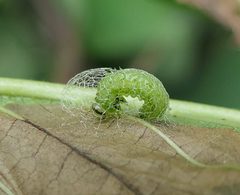
Early instar larvae create distinctive zigzag feeding patterns from leaf edge toward midrib—unmistakable and diagnostic for this . Later instars skeletonize leaves completely, making damage less distinctive. are small black with pale legs. The species can be distinguished from Sterictiphora sawflies, which also make zigzag patterns but feed on Prunus rather than Ulmus.
Images
Habitat
Associated with elm trees in natural forests, urban landscapes, and managed nurseries. Requires elm foliage for larval development. Overwinters as pupae in leaf litter and soil.
Distribution
Native to China and Japan. in Europe since 2003 (first recorded in Poland and Hungary, spread to England by 2017). Invasive in North America since 2020 (first detected in Quebec, Canada; now established in 14 U.S. states and four Canadian provinces as of 2026).
Seasonality
Multiple per year. Larval development completed in 2–3 weeks. emerge after 4–7 days of . Final autumn generation produces pupae that emerge the following spring.
Diet
Larvae feed on leaves of elm (Ulmus spp.) and, as recently documented, Japanese zelkova (Zelkova serrata). Early instars create zigzag feeding patterns; later instars skeletonize leaves.
Host Associations
- Ulmus spp. - primary Required for larval development; severe defoliation possible
- Zelkova serrata - alternate Documented in North America; used early in season when elm foliage unavailable, then shift back to elm
Life Cycle
Females reproduce via (no males known). Larvae progress through 4–7 instars over 2–3 weeks. occurs in cocoons attached to leaf undersides or in soil. Summer cocoons are transparent and lattice-like; autumn cocoons are thicker and solid, falling with leaves to overwinter in litter. Multiple annually.
Behavior
Larvae feed gregariously; dozens may occur on a single leaf. attach cocoons to inanimate objects including vehicles and wood products, facilitating long-distance through human-mediated transport. Cocoons have been documented on vehicle side mirrors and wheel wells.
Ecological Role
Herbivore and defoliator of elm trees. Capable of causing severe defoliation leading to tree decline, particularly when combined with other stressors such as drought or . No native North American ecological relationships established.
Human Relevance
Significant forest pest threatening elm and hybrids. Causes aesthetic damage and potential tree mortality in urban and managed landscapes. Spread facilitated by human transport of cocoons on vehicles and in potted nursery stock. Citizen science platforms (iNaturalist) have contributed to detection efforts.
Similar Taxa
- Sterictiphora spp.Also creates zigzag larval feeding patterns, but feeds on Prunus (cherry/plum) rather than Ulmus (elm)
More Details
Reproductive Biology
are entirely female and reproduce through , meaning a single individual can establish a new .
Dispersal Mechanisms
estimated to spread 28–56 miles (45–90 km) annually on their own; human-mediated transport through attached cocoons and soil movement likely accelerates spread.
Detection History
First North American detection was via iNaturalist observation in Quebec, 2020, highlighting the value of citizen science for monitoring.
Sources and further reading
- BugGuide
- Wikipedia
- GBIF taxonomy match
- iNaturalist taxon
- NCBI Taxonomy
- Inside the 'World of Insects' Calendar | Bug Squad
- Aproceros leucopoda Archives - Entomology Today
- The Elm Zigzag Sawfly is Cute, It's Spreading Fast, and Now It Wants Your Zelkova Trees
- Here We Go Again: Meet the Elm Zigzag Sawfly, Another Non-Native Forest Pest
- elm zigzag sawfly larva - Entomology Today
- elm zigzag sawfly damage - Entomology Today