
Aproceros
Malaise, 1931
Species Guides
1- Aproceros leucopoda(elm zigzag sawfly)
Aproceros is a of in the Argidae, comprising ten recognized native to eastern Asia. The genus gained international attention following the introduction of Aproceros leucopoda (elm zigzag sawfly) to Europe around 2003 and subsequently to North America in 2020. This has demonstrated rapid range expansion and significant defoliation capacity on elm trees (Ulmus spp.). Most Aproceros species remain restricted to their native East Asian ranges, with limited biological information available for the genus beyond A. leucopoda.

Pronunciation
How to pronounce Aproceros: /ˌæpɹoʊˈsiːɹoʊs/
These audio files are automatically generated. While they are not always 100% accurate, they are a good starting point.
Identification
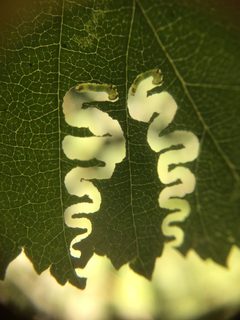
Aproceros are distinguished from other Argidae by genitalia , requiring microscopic examination. A. leucopoda is readily identified by its distinctive larval feeding damage: early instars create zigzag patterns from leaf edge toward midrib, while later instars skeletonize leaves. This zigzag pattern is unique among Ulmus-feeding insects; the only other with similar feeding pattern is Sterictiphora, which feeds on Prunus rather than Ulmus. Among Aproceros species, A. leucopoda has been introduced to Europe and North America, while other species remain to East Asia.
Images
Appearance
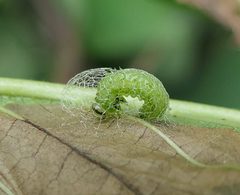
are small , typically under 10 mm in length. Larvae of A. leucopoda are green with distinctive black T-shaped markings on the . Early instar larvae are only a few millimeters long. Cocoons are found in soil or attached to inanimate objects such as vehicles and wood products. Detailed morphological descriptions for most in the are limited, though genitalia structures have been characterized for Russian species.
Habitat
Native occur in forested and wooded in eastern Asia where elms grow. A. leucopoda has established in urban forests, managed landscapes, arboretums, gardens, and natural elm stands in invaded regions.
Distribution
Native to eastern Asia including China (Gansu, Hebei, Yunnan), Japan (Hokkaido, Honshu), Kazakhstan, Korea (North and South), and the Russian Far East. A. leucopoda introduced to Europe (first recorded 2003 in Hungary and Poland, now present in at least 20 countries), and North America (first detected 2020 in Québec, 2021 in Virginia, now in 14 U.S. states and four Canadian provinces).
Seasonality
In temperate regions, activity begins in spring. In Hungary, up to four or five per year are potentially possible based on thermal requirements. Field observations in Italy recorded adult captures from April to October with up to six generations, though vary with weather conditions. occurs as cocoons in soil.
Diet
Larvae feed on leaves of Ulmus . A. leucopoda has been documented on at least 20 Ulmus , with Ulmus pumila appearing particularly susceptible. Japanese zelkova (Zelkova serrata) has been observed as an occasional alternate when elm foliage is unavailable, though laboratory studies indicate A. leucopoda cannot complete development on Zelkova. Other Aproceros species presumably feed on Ulmus, though host records are sparse.
Host Associations
- Ulmus pumila - primary Siberian elm; preferred with confirmed susceptibility
- Ulmus spp. - Multiple elm and hybrids utilized
- Zelkova serrata - occasional alternate Japanese zelkova; larvae can feed but development may not complete; used when elm unavailable
Life Cycle
Development includes , larval, prepupal, and pupal stages. Larvae pass through 4–7 instars, with 6th instar individuals showing highest developmental rate. Cocoons are formed in soil or attached to substrates. occurs in the cocoon stage. Thermal requirements: developmental threshold approximately 7°C, thermal constant ~430 for one . Optimal temperature range 15.0–19.5°C based on survival and .
Behavior
A. leucopoda exhibits : are entirely female and reproduce without mating. This reproductive mode enables single individuals to establish new . are estimated to disperse 45–90 km per year naturally. Cocoons attach to vehicles, wood products, and other inanimate objects, facilitating long-distance human-mediated . Larvae feed gregariously, with dozens sometimes present on single leaves.
Ecological Role
As a defoliator, A. leucopoda can cause repeated defoliation of trees, potentially weakening elms and causing branch dieback and reduced growth when combined with other stressors. In invaded regions, it adds to existing pressures on elm already affected by . Natural enemies including have been observed in Europe, though their efficacy remains unstudied. Population declines have been recorded in some areas after initial establishment, possibly due to natural enemy activity or environmental factors.
Human Relevance
A. leucopoda is an emerging pest of concern to forestry, urban tree management, and nursery industries. Its rapid spread and parthenogenetic make detection and management challenging. Monitoring focuses on characteristic zigzag feeding damage. Management tactics include physical removal and application in managed landscapes; few specific recommendations exist. Transport of potted nursery stock and cocoon-contaminated soil are suspected introduction . Citizen science platforms have contributed to detection efforts.
Similar Taxa
- SterictiphoraLarvae create similar zigzag feeding patterns, but feed on Prunus rather than Ulmus; distinguished by host association and
- AprosthemaHistorical taxonomic confusion; Aproceros pallidicornis was originally described as Aprosthema pallidicornis, clarified through morphological and molecular studies
More Details
Taxonomic history
Aproceros was established by Malaise in 1931. A. pallidicornis was originally described as Aprosthema pallidicornis by Mocsáry in 1909 and later transferred. A. umbricola Malaise, 1931 is a synonym of A. pallidicornis. Molecular genotyping has resolved morphological problems and clarified boundaries, seasonal dimorphism, and geographic variation in Russian species.
Research gaps
Biological information for most Aproceros remains limited, with A. leucopoda dominating published literature due to its status. Basic , associations, and distribution data are needed for the nine non-.
Sources and further reading
- BugGuide
- Wikipedia
- GBIF taxonomy match
- iNaturalist taxon
- NCBI Taxonomy
- Inside the 'World of Insects' Calendar | Bug Squad
- Aproceros leucopoda Archives - Entomology Today
- The Elm Zigzag Sawfly is Cute, It's Spreading Fast, and Now It Wants Your Zelkova Trees
- Here We Go Again: Meet the Elm Zigzag Sawfly, Another Non-Native Forest Pest
- elm zigzag sawfly larva - Entomology Today
- elm zigzag sawfly damage - Entomology Today
- Aproceros leucopoda Takeuchi. [Distribution map].
- Aproceros leucopoda . [Distribution map].
- Aproceros leucopoda . [Distribution map].
- Aproceros leucopoda (elm zigzag sawfly).
- Bionomics of the Non-Native Elm Defoliator Aproceros leucopoda (Hymenoptera, Argidae) in North-Eastern Italy
- First record of the Zigzag elm sawfly Aproceros leucopoda (Hymenoptera: Argidae) in Greece
- Host plant range of Aproceros leucopoda is limited within Ulmaceae
- Occurrence of the alien zigzag elm sawfly, Aproceros leucopoda (Hymenoptera: Argidae), in arboretums and botanical gardens of Hungary
- Figure 1 from: Blank SM, Köhler T, Pfannenstill T, Neuenfeldt N, Zimmer B, Jansen E, Taeger A, Liston AD (2014) Zig-zagging across Central Europe: recent range extension, dispersal speed and larval hosts of Aproceros leucopoda (Hymenoptera, Argidae) in Germany. Journal of Hymenoptera Research 41: 57-74. https://doi.org/10.3897/JHR.41.8681
- Biology, ecology and molecular characterization of Aproceros leucopoda (Takeuchi, 1939) (Hymenoptera: Argidae), pest of elms in the Middle Volga Region
- Figure 2 from: Blank SM, Köhler T, Pfannenstill T, Neuenfeldt N, Zimmer B, Jansen E, Taeger A, Liston AD (2014) Zig-zagging across Central Europe: recent range extension, dispersal speed and larval hosts of Aproceros leucopoda (Hymenoptera, Argidae) in Germany. Journal of Hymenoptera Research 41: 57-74. https://doi.org/10.3897/JHR.41.8681
- Temperature‐dependent development of Aproceros leucopoda (Hymenoptera: Argidae), an invasive pest of elms in Europe
- SPECIES OF THE GENUS APROCEROS MALAISE, 1931 (HYMENOPTERA: ARGIDAE) OF THE RUSSIAN FAUNA: MOLECULAR GENOTYPING RESOLVES MORPHOLOGICAL PROBLEMS
- Zig-zagging across Central Europe: recent range extension, dispersal speed and larval hosts of Aproceros leucopoda (Hymenoptera, Argidae) in Germany
- Figure 3 from: Blank SM, Köhler T, Pfannenstill T, Neuenfeldt N, Zimmer B, Jansen E, Taeger A, Liston AD (2014) Zig-zagging across Central Europe: recent range extension, dispersal speed and larval hosts of Aproceros leucopoda (Hymenoptera, Argidae) in Germany. Journal of Hymenoptera Research 41: 57-74. https://doi.org/10.3897/JHR.41.8681