
Townsendiella pulchra
Crawford, 1916
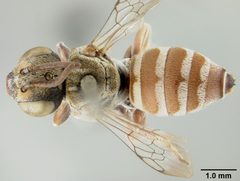
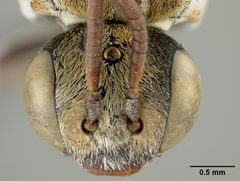
Townsendiella pulchra is a cuckoo bee ( Apidae, Nomadinae) known from the United States and Mexico. It is a kleptoparasite, meaning females lay in the nests of bees rather than constructing their own. The specifically targets Hesperapis larreae as its host. As a member of the tribe Townsendiellini, it belongs to a small group of specialized nomadine bees with limited documented natural history.
Pronunciation
How to pronounce Townsendiella pulchra: //taʊnˌsɛnˈdiːə ˈpʊlkra//
These audio files are automatically generated. While they are not always 100% accurate, they are a good starting point.
Images
Distribution
Recorded from the United States and Mexico. GBIF distribution records indicate presence in North America and Middle America.
Host Associations
- Hesperapis larreae - kleptoparasiteTownsendiella pulchra is a known kleptoparasite of this , laying in its nests
Behavior
Exhibits kleptoparasitic : females do not construct nests or provision with pollen, but instead deposit in the nests of Hesperapis larreae, where the resulting larvae consume the 's food stores.
Ecological Role
As a kleptoparasite, functions as a natural regulator of its Hesperapis larreae. Represents part of the diverse of bees that exploit the nesting efforts of other .
More Details
Taxonomic placement
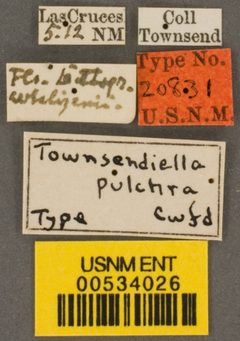
Townsendiella pulchra is the type of the Townsendiella, a small genus within the tribe Townsendiellini ( Nomadinae). The tribe is distinguished within Nomadinae by particular morphological features of the mouthparts and larval structures.
Etymology
The specific epithet 'pulchra' is Latin for 'beautiful', though detailed descriptions of the ' appearance in published literature are sparse.