
Epeolus howardi
Mitchell, 1962
Howard's Cellophane-cuckoo Bee
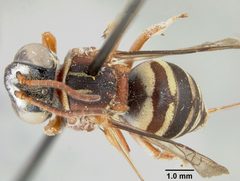
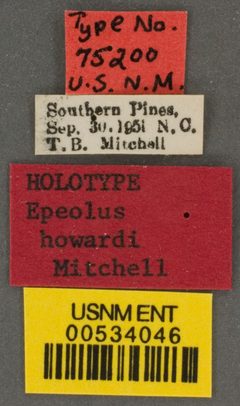
Epeolus howardi, commonly known as Howard's cellophane-cuckoo bee, is a of cleptoparasitic in the Apidae. As a member of the Epeolus, it is a nest that lays its in the nests of bees rather than constructing its own nest or collecting pollen. The species is known from North America and was described by Mitchell in 1962.
Pronunciation
How to pronounce Epeolus howardi: /ɛˈpiːələs ˈhaʊərdiː/
These audio files are automatically generated. While they are not always 100% accurate, they are a good starting point.
Identification
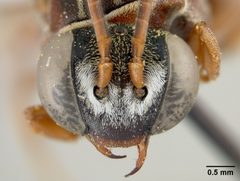
Epeolus howardi can be distinguished from other Epeolus by specific morphological features described in Mitchell's 1962 original description, though detailed diagnostic characters require examination of the and comparison with related species. Within the , species identification typically relies on patterns of hair coloration, body proportions, and male genitalia . The species may be confused with other small, sparsely-haired bees or due to its reduced pilosity, but can be recognized as a by its wing venation and other apid characteristics.
Images
Appearance
As a cuckoo bee in the Epeolus, E. howardi lacks the dense branched body hairs typical of pollen-collecting bees, instead possessing short black, white, red, and yellow hairs that form distinctive patterns. The body is relatively small, with members of the genus Epeolus ranging from 5.5–10.0 mm in length. The reduced hairiness gives these bees a -like appearance compared to fuzzy pollen-collecting bees.
Distribution
North America. Specific locality records are sparse, with the known from limited documented observations.
Host Associations
- Colletes - kleptoparasiteMembers of the Epeolus are known to parasitize nests of polyester bees in the genus Colletes; this association is presumed for E. howardi based on genus-level
Behavior
As a cleptoparasitic cuckoo bee, females lay in the nests of bees. The larva hatches and seeks out the host egg or larva, killing it and then consuming the pollen stores provisioned by the host female. do not collect pollen and lack the morphological adaptations for pollen transport seen in non-parasitic bees.
Ecological Role
Epeolus howardi functions as a in , exerting control on its . This parasitic lifestyle represents a specialized ecological interaction within the broader bee community structure.
Similar Taxa
- Other Epeolus speciesSimilar cleptoparasitic lifestyle, reduced body hair, and -like appearance; -level identification requires detailed morphological examination
- Nomada speciesAlso cleptoparasitic bees in Apidae with reduced hairiness; distinguished by different body proportions and wing venation patterns
- Small wasps (Vespidae, Crabronidae)Superficially similar due to sparse hair; distinguished by wing venation, presence of branched hairs (even if reduced), and other -specific morphological characters
More Details
Taxonomic history
Described by Mitchell in 1962. The name 'Epeolus' is thought to be a diminutive of Epeus/Epeius, the Greek soldier credited with devising the Trojan Horse, possibly alluding to the deceptive, infiltrating nature of these cleptoparasitic bees.
Conservation status
Data Deficient; known from limited observations with only 10 records in iNaturalist as of source date.