
Zacosmia maculata
(Cresson, 1879)
Spotted Mini-digger-Cuckoo
Zacosmia maculata is a of kleptoparasitic in the Apidae, tribe Melectini. As a cuckoo bee, females do not construct nests or collect pollen; instead, they lay in the nests of bees, primarily species of Hesperapis. The species occurs in western North America and parts of Middle America.
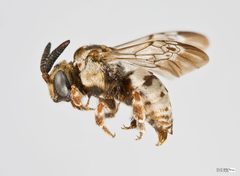
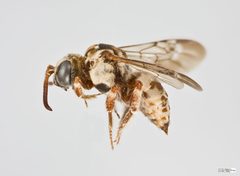
Pronunciation
How to pronounce Zacosmia maculata: /zaˈkɔz.mi.a maˈku.la.ta/
These audio files are automatically generated. While they are not always 100% accurate, they are a good starting point.
Images
Distribution
Western North America and Middle America. GBIF records indicate presence in both regions.
Host Associations
- Hesperapis - kleptoparasitePrimary for this cuckoo bee
Ecological Role
Kleptoparasite (cuckoo bee) that exploits nest provisions of bees, potentially affecting host .
Similar Taxa
- MelectaBoth are cuckoo bees in tribe Melectini with similar kleptoparasitic ; Zacosmia is distinguished by its smaller size and more western distribution.
Sources and further reading
- BugGuide
- GBIF taxonomy match
- iNaturalist taxon
- NCBI Taxonomy
- Catalogue of Life
- Be careful around baldfaced hornets, Dolichovespula maculata — Bug of the Week
- An inside look at baldfaced hornets, Dolichovespula maculata — Bug of the Week
- High fiber diets for baldfaced hornets? Nah, construction materials for enlarging nests: Baldfaced hornets, Dolichovespula maculata — Bug of the Week
- What do insects do in winter, Part 2? Tolerating the big chill: Banded woolly bears, Pyrrharctia isabella, field crickets, Gryllus spp., baldfaced hornets, Dolichovespula maculata, and others — Bug of the Week
- Bug Eric: Window-winged Moths
- Spiney, scaley distractions | Beetles In The Bush