
Melissodes stearnsi
Cockerell, 1905
long-horned bee
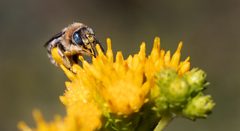
Melissodes stearnsi is a of long-horned bee in the Apidae, described by Cockerell in 1905. Like other members of the Melissodes, it belongs to the tribe Eucerini, a group of solitary, ground-nesting bees. The species is found in North America. Available information about this species specifically is limited, with most detailed behavioral and ecological knowledge coming from better-studied such as Melissodes agilis.
Pronunciation
How to pronounce Melissodes stearnsi: //mɛˈlɪsəˌdiːz ˈstɜrnzi//
These audio files are automatically generated. While they are not always 100% accurate, they are a good starting point.
Images
Distribution
North America
Similar Taxa
- Melissodes agilisA well-documented with similar male sleeping on flowers and territorial ; males of both cannot sting. M. stearnsi may share these traits but this has not been specifically documented.
- Melissodes robustiorAnother frequently mentioned in garden observations; males also sleep on flowers. Distinguishing M. stearnsi from these similar requires expert examination of morphological characters.
- Svastra obliquaClosely related in the same tribe Eucerini with similar ; males also exhibit sleeping on flowers and may be confused with Melissodes species in field observations.
More Details
Data limitations
Most detailed behavioral descriptions for Melissodes in available sources refer to M. agilis, M. robustior, or observed in California gardens. Specific documentation of M. stearnsi is sparse, with only 3 iNaturalist observations and minimal published natural history. Caution is warranted in assuming congener traits apply to this species.
Sources and further reading
- BugGuide
- Wikipedia
- GBIF taxonomy match
- iNaturalist taxon
- NCBI Taxonomy
- Catalogue of Life
- About Those Sleepovers... | Bug Squad
- The Year 2017: 'Survival of the Flittest' | Bug Squad
- What's Not to Love About 'Boys' Night Out'? | Bug Squad
- 2023: These Are a Few of My Favorite Things | Bug Squad
- Seen Any Monarchs Lately? | Bug Squad
- 'Bee' One in a Million | Bug Squad