
Melissodes robustior
Cockerell, 1915
robust long-horned bee
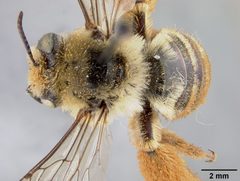
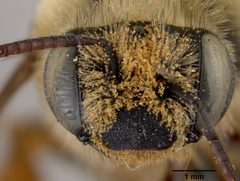
Melissodes robustior, commonly known as the robust long-horned bee, is a of long-horned bee in the Apidae. It is native to the West Coast of North America. Male individuals have been observed exhibiting the characteristic sleeping of the Melissodes, clustering on flowers or stems at night while females nest underground.

Pronunciation
How to pronounce Melissodes robustior: //məˈlɪs.oʊˌdiːz roʊˈbʌs.ti.ɔr//
These audio files are automatically generated. While they are not always 100% accurate, they are a good starting point.
Identification
As a member of the Melissodes, males likely possess the elongated that give long-horned bees their . Identification to level requires expert examination; Robbin Thorp, distinguished emeritus professor of entomology at UC Davis, identified specimens as "possibly M. robustior" based on visual characteristics in field observations.
Images
Habitat
Observed in gardens and areas with abundant flowering plants. Associated with Mexican sunflowers (Tithonia rotundifolia) and other nectar-rich blooms where males have been documented sleeping.
Distribution
West Coast of North America. Specific records include California, with observations from Vacaville in the Central Valley region.
Life Cycle
Females nest in the ground, creating burrows with distinctive round entrance holes approximately the diameter of a pencil or slightly smaller, sometimes with small piles of dirt resembling mini-volcanoes. Each female digs her own burrow. Males do not participate in nest construction.
Behavior
Male sleeping observed on flowers and stems, beginning around sunset and continuing until morning. Males cluster in groups on suitable perches, with some jostling for position initially. Sleeping aggregations are based on suitable perch availability rather than proximity to female nests, though typically within 100 yards of the nearest female nest. Males are territorial and will defend floral resources from other .
Ecological Role
Native . As a member of the tribe Eucerini, contributes to pollination of flowering plants in its range.
Human Relevance
Subject of citizen science observation and photography. Males cannot sting, making them harmless to humans. Contributes to garden biodiversity and serves as an educational example of native .
Similar Taxa
- Melissodes agilisClosely related with similar male sleeping on flowers; distinguished by subtle morphological differences requiring expert identification
- Svastra obliquaRelated long-horned bee with similar male roosting ; may co-occur in same and requires careful examination to distinguish
More Details
Taxonomic Note
Field identification to level within Melissodes is challenging. The specific epithet "robustior" (Latin comparative of "robustus," meaning more robust or stronger) suggests this species may be distinguishable by relatively stouter body proportions compared to , though this requires verification.
Sources and further reading
- BugGuide
- Wikipedia
- GBIF taxonomy match
- iNaturalist taxon
- NCBI Taxonomy
- Catalogue of Life
- What's Not to Love About 'Boys' Night Out'? | Bug Squad
- About Those Sleepovers... | Bug Squad
- The Year 2017: 'Survival of the Flittest' | Bug Squad
- 2023: These Are a Few of My Favorite Things | Bug Squad
- Seen Any Monarchs Lately? | Bug Squad
- 'Bee' One in a Million | Bug Squad