
Melissodes desponsus
Smith, 1854
Eastern Thistle Longhorn Bee
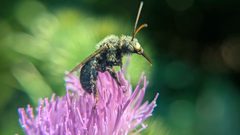
Melissodes desponsus is a solitary, ground-nesting longhorn native to northeastern North America. Females are oligolectic on Cirsium thistles, collecting white pollen that often obscures their distinctive orange scopae. The is active in mid-to-late summer and has been assessed as vulnerable or imperiled in several regional conservation evaluations, though it lacks a comprehensive rangewide status assessment.


Pronunciation
How to pronounce Melissodes desponsus: /mɛˈlɪsoʊdiːz dɛsˈpɒnsəs/
These audio files are automatically generated. While they are not always 100% accurate, they are a good starting point.
Identification
Distinguished from other Melissodes by the combination of orange scopae in females (often hidden under white pollen), pale yellow , and strict association with Cirsium thistles. Males identified by yellow and long . May be confused with other Eucerini, but the specific plant association and northeastern distribution help separate it from western like M. agilis or M. robustior.
Images
Appearance
Medium-sized with pale yellow and black . Females measure 12–13.5 mm and possess orange scopae on the hind legs, frequently coated with white Cirsium pollen. Males measure 11–13.5 mm, have longer (the 'longhorn' trait characteristic of the ), and display yellow . Both sexes show the typical Melissodes body plan with robust hind legs in females for pollen transport.
Habitat
Open supporting Cirsium thistles, including meadows, fields, and disturbed areas. Requires bare or sparsely vegetated ground for nesting.
Distribution
Northeastern quadrant of the United States, extending into southern Canada. Records from Vermont and broader northeastern North America.
Seasonality
Active mid-to-late summer.
Diet
Females are oligolectic on Cirsium thistles. Nectar sources presumably include Cirsium and possibly other flowers, though specific documentation is limited.
Host Associations
- Cirsium - pollen source plant; females collect white pollen that often covers the orange scopae
Life Cycle
Ground-nesting solitary . Females excavate individual burrows, sometimes clustered, with entrance holes approximately pencil-diameter or smaller, often with small soil mounds. Males do not participate in nest construction.
Behavior
Males have been observed in sleeping on vegetation in related Melissodes , though specific documentation for M. desponsus is not confirmed. Females are active foragers on thistles during daylight hours.
Ecological Role
of Cirsium thistles. Contributes to thistle and serves as a food source for and in native .
Human Relevance
Contributes to pollination of native thistles; potential for health in northeastern meadows. No documented economic importance or negative impacts.
Similar Taxa
- Melissodes agilisWestern with similar male sleeping and territorial , but occurs in different geographic range (western North America) and has different associations
- Melissodes robustiorSimilar size and , but distinguished by distribution and subtle morphological differences; may require examination of male genitalia or specific scopal coloration
- Svastra obliquaRelated Eucerini that shares longhorn and male roosting , but belongs to different with distinct facial markings and preferences
More Details
Taxonomic history
Originally described with sexually dimorphic : females as Melissodes desponsa and males as M. nigripes by Frederick Smith in 1854. Later synonymized under M. desponsus.
Conservation status
Listed as vulnerable or imperiled by several regional sources, though no comprehensive IUCN or federal assessment exists. Status reflects loss and potential declines in native thistle .
Nesting biology
Nests are individual burrows dug by females in the ground, with entrance holes about pencil-diameter or slightly smaller, sometimes with small soil piles resembling 'mini-volcanoes.' Nest patterns vary from widely separated to clustered depending on local soil conditions.
Sources and further reading
- BugGuide
- Wikipedia
- GBIF taxonomy match
- iNaturalist taxon
- NCBI Taxonomy
- Catalogue of Life
- About Those Sleepovers... | Bug Squad
- The Year 2017: 'Survival of the Flittest' | Bug Squad
- What's Not to Love About 'Boys' Night Out'? | Bug Squad
- 2023: These Are a Few of My Favorite Things | Bug Squad
- Seen Any Monarchs Lately? | Bug Squad
- 'Bee' One in a Million | Bug Squad