
Melissodes bimaculatus
(Lepeletier, 1825)
Two-spotted Longhorn Bee, two-spotted longhorn
Melissodes bimaculatus, commonly known as the two-spotted longhorn , is a solitary bee in the Apidae. It is a member of the long-horned bee tribe Eucerini, characterized by males having exceptionally long . The species is native to North America and has been documented as an early-season in agricultural settings, particularly in pumpkin patches. It is one of the bee species used in mark-recapture studies to evaluate wild bee sampling protocols.
Pronunciation
How to pronounce Melissodes bimaculatus: //mɛˈlɪs.oʊˌdiːz baɪˌmæk.jəˈleɪ.təs//
These audio files are automatically generated. While they are not always 100% accurate, they are a good starting point.
Identification
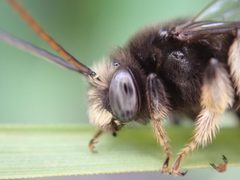
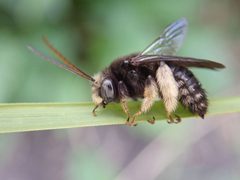
Distinguished from other Melissodes by the two pale facial or thoracic spots referenced in the specific epithet. Males are readily identified by their extremely long, thread-like that exceed body length—a trait shared with other Eucerini but particularly pronounced in this . The species may be confused with other long-horned bees (Eucerini) in the same genus; precise identification requires examination of specific spot patterns and genitalic . From similar-sized bees like bumble bees (Bombus), it differs in being solitary rather than social, and males lack the robust, rounded body form of male bumble bees.
Images
Appearance
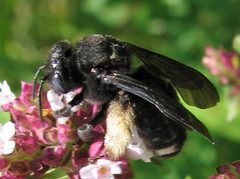
Medium-sized solitary with males distinguished by conspicuously long extending well beyond the body—characteristic of the 'longhorn' . The exhibits the typical robust, hairy body form of apid bees. The 'two-spotted' designation likely refers to distinct pale or light-colored markings on the or , though specific pattern details require direct observation. Females possess scopae (pollen-collecting hairs) on the hind legs.
Habitat
Found in open, sunny including agricultural fields, meadows, and early successional areas. Documented in pumpkin patches and other cucurbit agricultural settings. Associated with flowering herbaceous vegetation.
Distribution
Native to North America. Documented presence in the eastern United States including North Carolina, Maryland, and Vermont. GBIF records indicate distribution across North America with confirmed presence in the northeastern United States.
Seasonality
Early-season active , documented in pumpkin patches in early summer. Activity period extends from late spring through summer based on mark-recapture study timing (May–August).
Diet
pollen and nectar feeder. Documented visiting flowers of Portulaca 'Sundial Light Pink' and cucurbit crops. As a member of Eucerini, likely exhibits preference for composite flowers (Asteraceae) though specific floral associations require further documentation.
Life Cycle
Solitary with typical apid : females construct individual nests in soil, provision with pollen and nectar, and lay single . Larvae develop through complete (egg, larva, pupa, ). Specific nest architecture and details not documented in available sources.
Behavior
Solitary forager, non-aggressive. Males have been observed patrolling flowers for mates. Exhibits early-morning foraging activity in agricultural settings. activity documented during daylight hours with specific visitation patterns to flowers that open in morning hours.
Ecological Role
of wild and cultivated flowering plants. Documented as a visitor to ornamental cultivars and agricultural crops including cucurbits. Contributes to early-season pollination services in temperate North American .
Human Relevance
Agricultural with documented presence in pumpkin production. Subject of ecological research on wild sampling methodology—used as a study in mark-recapture experiments validating aerial netting versus pan trap sampling protocols. Potential for pollinator-friendly plant labeling in horticulture industry.
Similar Taxa
- Melissodes spp.Other in share long male and general body form; distinguished by specific spot patterns and genitalic characters requiring expert examination.
- Peponapis pruinosa (Eastern cucurbit bee)Co-occurs in pumpkin patches and shares agricultural ; differs in being oligolectic (specialized on cucurbits) versus foraging, and lacks the pronounced male antennal elongation.
- Bombus spp. (bumble bees)Similar size and general appearance; distinguished by social , colony nesting, and males with short and robust rather than elongate body form.
- Xylocopa virginica (Eastern carpenter bee)Co-occurs in eastern North America and similar size; distinguished by large, shiny, nearly hairless and wood-nesting versus ground-nesting.
More Details
Research significance
Melissodes bimaculatus was one of four focal in a 2020 mark-recapture study by Briggs et al. evaluating detectability of wild sampling methods. The study found that aerial netting better reflected true abundance than pan traps for this species.
Pollinator attractiveness research
Documented as a visitor to Portulaca 'Sundial Light Pink' in -attractiveness trials, though visitation was inconsistent and time-of-day dependent—appearing en masse on some days but absent on others.
Subspecies
Two recognized: Melissodes bimaculatus bimaculatus (Lepeletier, 1825) and Melissodes bimaculatus nullus LaBerge, 1956.