
Bombus suckleyi
Greene, 1860
Suckley's Cuckoo Bumble Bee, Suckley's Bumble Bee
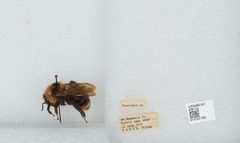
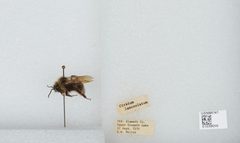
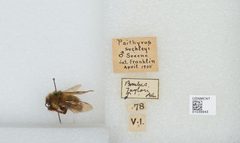
Bombus suckleyi is a cuckoo (subgenus Psithyrus) and obligate social of other Bombus . It lacks corbiculae () on its hind legs, having lost the ability to collect pollen and nectar for its own . The species invades colonies, kills or subdues the resident , and manipulates host to provision its offspring. Native to northwestern North America, it has experienced severe declines of approximately 77% and is classified as critically endangered by the IUCN and NatureServe.
Pronunciation
How to pronounce Bombus suckleyi: /ˈbɒmbəs ˈsʌk.li.aɪ/
These audio files are automatically generated. While they are not always 100% accurate, they are a good starting point.
Identification
Distinguished from other cuckoo bumble bees by the yellow T4 with a central black patch (Bombus bohemicus has T4 entirely yellow). Similar include Bombus insularis, Bombus flavidus, and Bombus bohemicus. Absence of corbiculae separates all Psithyrus from non-parasitic Bombus subgenera. Males distinguished by convex hind legs with sparse hairs compared to female's densely hairy convex tibia.
Images
Habitat
Western meadows across a wide range of elevations, particularly higher elevation meadows within forest or subalpine zones. Requires suitable colonies for , continuous floral resources through the growing season, and undisturbed sites for . Historically found in patchy meadow-complexes interspersed with forests or in field margins and hedgerows within agricultural landscapes.
Distribution
Northwestern North America: Alaska, western and central Canada (all 10 provinces, with historic records concentrated in southern British Columbia, Alberta, and Saskatchewan plus a disjunct in Newfoundland), and 11 western United States. Current range severely reduced, with more than 50% of historic range lost.
Seasonality
Females active late May to late October in California, with peak activity in June. Males active early July to late September in California, with peaks in late July and early September. Females emerge later than to facilitate colony invasion.
Diet
forager. feed on nectar and pollen from diverse flowers, primarily Asteraceae (Aster, Chrysothamnus, Cirsium, Solidago) and some Fabaceae (Trifolium). Documented floral associations include Cirsium (15 observations), Aster sp. (11), Centaurea repens (10), and Trifolium sp. (4).
Host Associations
- Bombus occidentalis - primary Western bumble bee; documented breeding
- Bombus terricola - Recorded in colonies
- Bombus rufocinctus - Recorded in colonies
- Bombus fervidus - Recorded in colonies
- Bombus nevadensis - Recorded in colonies
- Bombus appositus - Recorded in colonies
Life Cycle
Obligate social with no —all individuals are reproductively capable. Females emerge in spring, forage until locating suitable colony, then invade by killing or subduing resident . Host workers provision parasite offspring. Developed individuals leave nest to mate. Mated females feed on nectar and pollen before in loose soil, leaf litter, or debris. Males die after mating. No independent colony founding; entirely dependent on host for rearing.
Behavior
Females locate and invade established colonies, using aggression to usurp the resident . Manipulates host through chemical or behavioral dominance to continue colony maintenance and larval provisioning. Forages for sustenance but does not collect resources for offspring. Exhibits delayed relative to host to ensure availability of established colonies for invasion.
Ecological Role
of wildflowers and crops through foraging. As an obligate , are tightly coupled to abundance. Declines indicate broader stress affecting . Contributes to pollination of Asteraceae and Fabaceae species in meadow ecosystems.
Human Relevance
Subject of conservation concern due to severe decline. Listed as critically endangered by IUCN and NatureServe (G1). Petitioned for U.S. Act protection in 2020. Listed under California Endangered Species Act as of June 2019. Declines attributed to collapse, , loss, competition from non-native bees, climate change, and Nosema bombi exposure. Agricultural interests have opposed listing due to regulatory concerns.
Similar Taxa
- Bombus bohemicusSimilar size and general appearance; distinguished by T4 being entirely yellow rather than yellow with central black patch
- Bombus insularisOverlapping range and cuckoo ; color pattern differences in abdominal tergites
- Bombus flavidusSimilar parasitic lifestyle and subgenus Psithyrus; specific tergite coloration patterns differ
More Details
Conservation Status Details
NatureServe ranking G1 (critically imperiled) since 2018. IUCN critically endangered. Estimated 77% overall decline with relative abundance at less than 10% of historic levels. Designated of 'great conservation need' in Washington, Idaho, Colorado, and California. Legal status in California confirmed after court challenge regarding protection under state act.
Taxonomic Notes
Named after biologist George Suckley. Classified in subgenus Psithyrus along with all cuckoo bumble bees. Recognized as valid by ITIS. First described by John Greene in 1860.
Sources and further reading
- BugGuide
- Wikipedia
- GBIF taxonomy match
- iNaturalist taxon
- NCBI Taxonomy
- Catalogue of Life
- The Buzz: Protecting Our Bumble Bees | Bug Squad
- Remembering the Legendary Robbin Thorp | Bug Squad
- Celebrating Bumble Bees on World Bee Day | Bug Squad
- Bumble Bee Mellowing Out on the Mallow | Bug Squad
- California Has No State Bee--Yet! | Bug Squad
- Saving California's Bumble Bees: Become a Citizen Scientist | Bug Squad