
Bombus insularis
(Smith, 1861)
Indiscriminate Cuckoo Bumble Bee
Bombus insularis is a cuckoo in the subgenus Psithyrus, native to northern and western North America. As a social , it invades nests of bumble bee , usurps the resident , and exploits host to rear its own offspring. The species is known for its broad host range, attacking multiple bumble bee species across diverse including tundra, taiga, and mountain ranges.
Pronunciation
How to pronounce Bombus insularis: /ˈbɒm.bəs ɪnˈsuː.lə.rɪs/
These audio files are automatically generated. While they are not always 100% accurate, they are a good starting point.
Identification
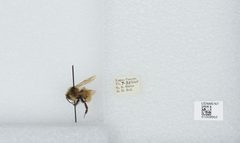
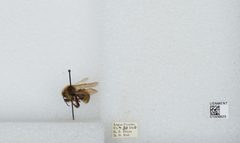
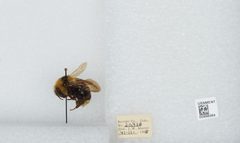
Distinguished from non-parasitic bumble bees by its status in subgenus Psithyrus and associated behavioral . Females lack pollen-carrying corbiculae () on hind legs, a trait shared with other cuckoo bumble bees. The combination of black with yellow tufts, pale yellow thoracic hairs, and black with yellow lateral markings separates it from many sympatric Bombus . Male color pattern differs notably from female, with more extensive black on head and banded abdomen.
Images
Appearance
Females measure 16–19 mm long and approximately 10 mm wide. The is black with yellow hair tufts. The is covered in long pale yellow hairs. Legs are black and hairy. The is black with yellow along the sides. Males are smaller, approximately 5 mm wide at the abdomen, with long black head hairs and small yellow patches; the abdomen has alternating yellow and black hair bands.
Habitat
Occupies tundra and taiga , western mountain ranges, and maritime regions. Found in northern forests, alpine meadows, and subarctic environments. The broad geographic range encompasses diverse climatic zones from Arctic to temperate montane .
Distribution
Native to northern and western North America. Occurs throughout Canada, Alaska, northern United States, and extends into some western states. Documented in Vermont and other northern tier states. Range spans from Arctic and subarctic regions through zones to western montane systems.
Host Associations
- Bombus appositus - white-shouldered bumblebee
- Bombus fervidus - yellow bumblebee
- Bombus flavifrons - yellow-fronted bumblebee
- Bombus nevadensis - Nevada bumblebee
- Bombus ternarius - orange-belted bumblebee
- Bombus huntii - documented in Utah usurpation study
Life Cycle
As a social , B. insularis does not construct its own nest or rear its own . The enters an established colony, kills or subdues the resident queen, and lays that are reared by host workers. The produces no worker of its own; offspring are exclusively reproductive males and females.
Behavior
Queens actively search for colonies across landscapes, with documented distances of at least 3.5–7 km. Usurpation of host nests occurs rapidly; in field studies, 13 of 16 deployed host colonies were invaded within 12 days. The exhibits broad host flexibility, attacking multiple species. Nest invasion is the sole reproductive strategy; no independent nest founding occurs.
Ecological Role
Social that reduces of colonies through nest usurpation. By exploiting host labor and nest resources, B. insularis redirects host colony productivity to its own . genetic data indicate high rates of nest invasion in areas where host colonies are abundant, with potential to impact local host .
Human Relevance
Of concern to commercial operations due to high usurpation rates on field-deployed colonies. Research demonstrates that fabricated excluders can prevent invasion with 100% effectiveness, suggesting management options for -dependent agriculture. Not directly involved in crop pollination due to parasitic lifestyle.
Similar Taxa
- Bombus suckleyiAlso a Psithyrus cuckoo with overlapping range in western North America; distinguished by more restricted associations and different coloration
- Other Psithyrus speciesShare social and lack of corbiculae; separated by range, distribution, and morphological details
More Details
Conservation context
While B. insularis remains common and widespread, it has declined in some areas and disappeared from parts of its historical range. Declines of may indirectly threaten this . The species' indiscriminate host use may buffer it against host-specific declines, though dependence on multiple host species creates complex .
Research significance
Genetic studies using microsatellite data reveal that B. insularis females originate from numerous distinct colonies, indicating widespread and successful across the landscape. Sibship analysis documents sibling between sites separated by over 7 km, demonstrating substantial mobility in search of .
Sources and further reading
- BugGuide
- Wikipedia
- GBIF taxonomy match
- iNaturalist taxon
- NCBI Taxonomy
- Catalogue of Life
- Look Out, Franklin's Bumble Bee, They're Coming for You! | Bug Squad
- Celebrating Bumble Bees on World Bee Day | Bug Squad
- Bumble Bee Mellowing Out on the Mallow | Bug Squad
- 'Am I Even a Bee?' Identity Crisis Unfolds in This Charming Book | Bug Squad
- Saving the Rusty-Patched Bumble Bee | Bug Squad
- The Buzz: Protecting Our Bumble Bees | Bug Squad
- Genetic and Usurpation Data Support High Incidence of Bumble Bee Nest Invasion by Socially Parasitic Bumble Bee, Bombus insularis