
Bombus natvigi
Richards, 1931
High Arctic Bumble Bee
Bombus natvigi is a cuckoo to the Nearctic Arctic, recognized as a distinct from Bombus hyperboreus in 2015 based on genetic analysis. It is a that invades colonies of Bombus polaris, using to manipulate into rearing its offspring. The species is currently listed as Data Deficient by the IUCN Red List, reflecting limited knowledge of its status and . Its taxonomic status remains debated, with some subsequent studies treating it as a of B. hyperboreus.
Pronunciation
How to pronounce Bombus natvigi: /ˈbɔm.bus ˈnæt.vɪˌgiː/
These audio files are automatically generated. While they are not always 100% accurate, they are a good starting point.
Identification
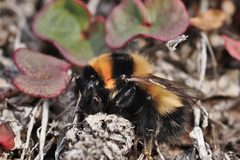
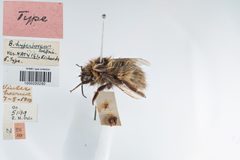
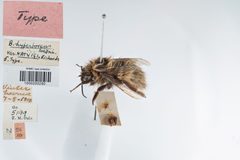
Plain black ; and with yellow and black banding; two yellow segments on the metasoma followed by four black segments. Distinguished from Bombus hyperboreus by genetic differentiation and geographic separation (Nearctic vs. Palearctic), though morphological differences are subtle.
Images
Habitat
High Arctic tundra environments in northern Canada and Alaska.
Distribution
Northern Canada and Alaska (Nearctic).
Host Associations
- Bombus polaris - Females use to invade colonies and alter to tend to her and her .
Similar Taxa
- Bombus hyperboreusOriginally synonymized with B. natvigi; separated in 2015 based on genetic analysis, though some subsequent studies treat natvigi as a of hyperboreus. B. hyperboreus occurs in the Palearctic (Greenland, northern Scandinavia, Russia), while B. natvigi is restricted to the Nearctic.
More Details
Taxonomic uncertainty
While initially recognized as a full in 2015, subsequent studies have questioned whether genetic differentiation is sufficient for species-level status, with some authorities treating B. natvigi as a of B. hyperboreus.
Conservation status
Listed as Data Deficient by IUCN Red List due to insufficient information on size, trends, and threats.
Sources and further reading
- BugGuide
- Wikipedia
- GBIF taxonomy match
- iNaturalist taxon
- NCBI Taxonomy
- Catalogue of Life
- Celebrating Bumble Bees on World Bee Day | Bug Squad
- Bumble Bee Mellowing Out on the Mallow | Bug Squad
- The Buzz: Protecting Our Bumble Bees | Bug Squad
- California Has No State Bee--Yet! | Bug Squad
- Saving California's Bumble Bees: Become a Citizen Scientist | Bug Squad
- Bumble Bees: Feeling Impact of Climate Change | Bug Squad