
Bombus franklini
(Frison, 1921)
Franklin's bumble bee, Franklin's bumblebee
Bombus franklini is a critically endangered with the most restricted range of any bumble bee in the world, confined to a 13,300-square-mile area spanning five counties in southern Oregon and northern California. The species has not been observed since 2006, despite intensive monitoring by entomologist Robbin Thorp from 1998 until his death in 2019. Listed as endangered under the U.S. Act in 2021, it is feared extinct due to severe decline from an estimated 94 individuals in 1998 to zero confirmed sightings since 2006. Genomic research indicates long-term population decline driven by bottlenecks and environmental stressors rather than alone.
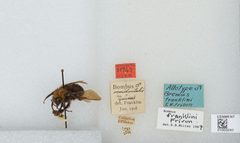
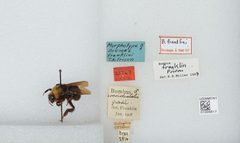
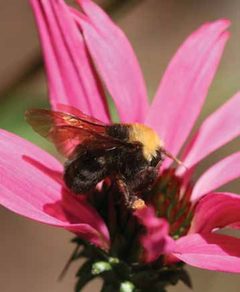
Identification
The inverted U-shaped yellow marking between the wing bases distinguishes this from sympatric bumble bees. The combination of mostly black with white tip, yellow , and restricted geographic range to the Siskiyou-Cascade region provides additional separation from Bombus occidentalis and other similar species. Specimen examination or expert verification required for reliable identification.
Images
Appearance
Mostly black body with distinctive yellow markings on the and top of the . The is solid black with a small white tip. A key diagnostic feature is an inverted U-shaped yellow marking between the wing bases on the thorax. Overall similar in size and general form to other black-and-yellow bumble bees, requiring close examination for positive identification.
Habitat
Montane meadows and alpine in the Siskiyou-Cascade mountain range, between the Coast Range and Sierra-Cascade Ranges. Associated with open meadow vegetation including lupines, California poppies, and mints. Elevations and specific microhabitat requirements within this narrow range are not well documented due to limited survey data.
Distribution
to a 190 × 70 mile (310 × 110 km) area in southern Oregon (Douglas, Jackson, and Josephine counties) and northern California (Siskiyou and Trinity counties). The smallest documented range of any globally. Formerly present in southwest Washington. No verified records outside this five-county region.
Seasonality
season from mid-May through September, based on historical observations. Peak activity period and of queens are not documented due to lack of recent observations.
Diet
Collects pollen primarily from lupines (Lupinus) and California poppies (Eschscholzia californica). Gathers nectar mainly from mints (Mentha, Monardella). Has been observed visiting vetch, wild roses, blackberries, clover, sweet peas, and mountain pennyroyal.
Ecological Role
of montane wildflowers, particularly lupines and poppies. As a native , it likely contributed to buzz pollination services and plant reproductive success in its restricted alpine meadow . The potential cascade effects of its loss on plant and dependent wildlife have been discussed but not quantified.
Human Relevance
Designated as endangered under the U.S. Act in 2021—the first in the western United States to receive this protection. Subject of intensive conservation interest, including multi-year search efforts by the U.S. Fish and Wildlife Service and citizen science initiatives. Robbin Thorp's decades-long monitoring campaign raised public awareness of decline. The serves as a flagship for conservation and the impacts of commercial bee-mediated transmission.
Similar Taxa
- Bombus occidentalisOverlaps in range and shares black-and-yellow coloration; distinguished by different thoracic pattern lacking the inverted U-shaped marking, and by presence of more extensive yellow on
- Bombus vosnesenskiiSympatric in parts of range but has yellow and more extensive yellow markings; lacks the distinctive U-shaped thoracic marking
More Details
Conservation History
Petitioned for ESA listing in 2010 by Robbin Thorp and the Xerces Society; proposed for listing in 2019; final rule published 2021. IUCN Red List classification as Critically Endangered since 2010.
Research Findings
2024 genomic study (Schweizer et al., PNAS) analyzing museum specimens from 1950–1998 found critically low genetic diversity and decline since the late Pleistocene, contradicting hypotheses that alone drove recent collapse.
Etymology
Named in 1921 by T.H. Frison in honor of Henry J. Franklin, who published the monograph 'The Bombidae of the New World' in 1912–1913.
Sources and further reading
- BugGuide
- GBIF taxonomy match
- iNaturalist taxon
- NCBI Taxonomy
- Catalogue of Life
- Franklin's Bumble Bee May Be Protected: A Legacy of Robbin Thorp | Bug Squad
- Look Out, Franklin's Bumble Bee, They're Coming for You! | Bug Squad
- Robbin Thorp and Franklin's Bumble Bee | Bug Squad
- Robbin Thorp: Chasing Franklin's Bumble Bee | Bug Squad
- Celebrating Bumble Bees on World Bee Day | Bug Squad
- Saving California's Bumble Bees: Become a Citizen Scientist | Bug Squad