
Bombus cryptarum
(Fabricius, 1775)
cryptic bumblebee, Cryptic Bumble Bee
Bombus cryptarum is a widespread bumblebee native to the northern hemisphere, occurring across Europe, Asia, and western North America. It belongs to the subgenus Bombus sensu stricto, a of morphologically similar and difficult-to-distinguish bees. The species was only recently confirmed in the British Isles and its complete distribution remains unclear due to ongoing taxonomic uncertainties. Several have been described, including the endangered B. cryptarum florilegus in Japan and the recently described B. cryptarum pallidocinctus.
Pronunciation
How to pronounce Bombus cryptarum: /ˈbɒmbʊs ˈkrɪptərəm/
These audio files are automatically generated. While they are not always 100% accurate, they are a good starting point.
Identification
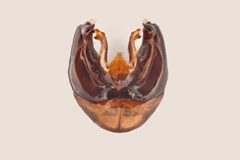
Bombus cryptarum is morphologically cryptic and difficult to distinguish from other members of the Bombus sensu stricto complex, particularly B. lucorum and B. magnus. Reliable identification requires molecular analysis: mitochondrial sequencing shows 22-44 base substitutions and Tamura-Nei of 0.027-0.042 from B. lucorum, B. magnus, and B. patagiatus. Diagnostic substitutions at 8-20 positions can characterize the . Male labial gland secretions and differ phylogenetically from B. magnus.
Images
Habitat
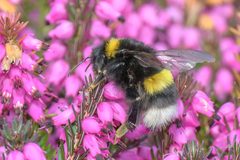
In northern areas, occurs on plains in heather . In southern regions, found in mountain . Forests and woody edges may serve as important habitat for foraging, nesting, and based on broader .
Distribution
Circumpolar distribution throughout Europe, Asia, and western North America. Easternmost known localities in the Caucasus and Elburz Mountains; also recorded in Central Asiatic Mountains, Himalayas, Russian Transbaikal region, and Russian Far East. Confirmed in Moravian territory of Czech Republic through molecular analysis. Recently identified in the British Isles.
Life Cycle
Queens captured in spring can establish colonies. Laboratory rearing using methods adapted from B. terrestris protocols successfully produced complete nests, including second- queens that established their own .
Behavior
A single Bombus terrestris has been observed to raise young B. cryptarum queens in laboratory conditions, indicating potential for interspecific worker care. Cross-mating between B. cryptarum florilegus and the introduced B. terrestris has been documented in the Nemuro Peninsula, Japan, facilitated by sex pheromonal cross-activity.
Ecological Role
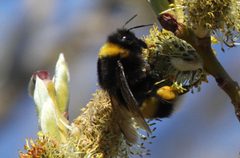
. As a bumblebee, performs buzz pollination, vibrating wing muscles to dislodge pollen from flowers.
Human Relevance
The endangered Japanese B. cryptarum florilegus has low genetic diversity and requires conservation attention. Hybridization with introduced B. terrestris threatens native in Japan. The has been successfully reared in laboratory settings using protocols developed for commercial bumblebee species.
Similar Taxa
- Bombus lucorumMorphologically similar member of Bombus sensu stricto complex; distinguished by 22-44 mitochondrial base substitutions and of 0.027-0.042
- Bombus magnusMorphologically similar; distinguished phylogenetically and by differences in labial gland secretions
- Bombus patagiatusMember of same ; distinguished by mitochondrial divergence
Sources and further reading
- BugGuide
- Wikipedia
- GBIF taxonomy match
- iNaturalist taxon
- NCBI Taxonomy
- Catalogue of Life
- Celebrating Bumble Bees on World Bee Day | Bug Squad
- Bumble Bee Mellowing Out on the Mallow | Bug Squad
- The Buzz: Protecting Our Bumble Bees | Bug Squad
- California Bumble Bee Atlas: What Citizens Found on a UC Davis Bumble Bee Walk | Bug Squad
- Robbin Thorp: Chasing Franklin's Bumble Bee | Bug Squad
- Do Forests Play a Role in Bumble Bee Life History? | Bug Squad
- Notes on distribution of Bombus cryptarum (Hymenoptera, Apoidea) in Moravian territory (Czech Republic) and its laboratory rearing
- Haplotypes, median networks, and diagnostic characters as tools to elucidate the intraspecific genetic and taxonomic structure of bumblebees, with a description of Bombus cryptarum pallidocinctus new subspecies (Hymenoptera: Apidae: Bombus).
- Phylogenetic relationships of the bumblebees Bombus moderatus, B. albocinctus, B. burjaeticus, B. florilegus and B. cryptarum based on mitochondrial DNA markers: a complex of closely related taxa with circumpolar distribution. (Hymenoptera: Apidae: Bombus).
- Cross-mating between the alien bumblebee Bombus terrestris and two native Japanese bumblebees, B. hypocrita sapporensis and B. cryptarum florilegus, in the Nemuro Peninsula, Japan
- Identification of cryptic species Bombus lucorum-complex and Bombus terrestris in Penza region using the PCR–RFLP method