
Bombus cockerelli
Franklin, 1913
Cockerell's Bumble Bee, Cockerell's Bumblebee
Bombus cockerelli is a with the smallest known range of any bumble bee species worldwide, restricted to high-elevation localities in the White Mountains of New Mexico. First described in 1913 from six specimens, it remained unobserved between 1956 and 2011. Fewer than 30 specimens have ever been collected. The species was once considered a potential , but fresh specimens now allow for genetic analysis to resolve its taxonomic status. Its entire range falls within protected U.S. National Forest and tribal lands.

Pronunciation
How to pronounce Bombus cockerelli: //ˈbɒm.bəs ˈkɒk.əˌrɛl.aɪ//
These audio files are automatically generated. While they are not always 100% accurate, they are a good starting point.
Identification
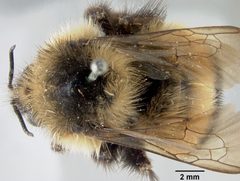
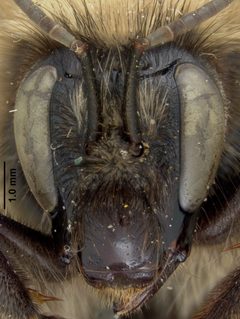
Distinguished from the similar high-altitude Bombus balteatus by three characters: shorter ; numerous intermixed black hairs on the (not uniform yellow); and yellow abdominal apex (not rust-tinted). The combination of yellow thorax with black hairs intermixed and the specific abdominal segment color pattern (segments 3–4 black, others yellow) is diagnostic.
Images
Habitat
High-elevation montane environments in the White Mountains of New Mexico, at altitudes exceeding 2,000 m (6,500 ft). Specific microhabitat requirements are unknown.
Distribution
Extremely restricted range: White Mountains of New Mexico, USA, within an area of less than 780 km² (300 square miles). All known localities are in high-elevation terrain.
Seasonality
Collection records span multiple months, but specific seasonal activity patterns are unknown due to extreme rarity of observations.
Ecological Role
Presumed based on -level traits; specimens have been collected on thistle flowers (Cirsium spp.). Specific functions are undocumented.
Human Relevance
Not known to interact directly with humans. Conservation status is considered stable due to full protection of its range within U.S. National Forest and tribal lands, despite extreme rarity and limited observations. The exemplifies the challenge of assessing conservation status for rarely encountered .
Similar Taxa
- Bombus balteatusOverlaps in high-altitude and general yellow-black coloration; distinguished by longer , uniform yellow without intermixed black hairs, and rust-tinted (not yellow) abdominal apex
Sources and further reading
- BugGuide
- Wikipedia
- GBIF taxonomy match
- iNaturalist taxon
- Catalogue of Life
- Celebrating Bumble Bees on World Bee Day | Bug Squad
- Bumble Bee Mellowing Out on the Mallow | Bug Squad
- The Buzz: Protecting Our Bumble Bees | Bug Squad
- California Has No State Bee--Yet! | Bug Squad
- Saving California's Bumble Bees: Become a Citizen Scientist | Bug Squad
- Bumble Bees: Feeling Impact of Climate Change | Bug Squad