
Protandrena
Cockerell, 1896
mining bees
Species Guides
3Protandrena is a of solitary mining bees in the Andrenidae, containing 50–180 described depending on taxonomic circumscription. Most species nest underground in sunny areas with sparse vegetation, constructing lined with a protective chemical 'wallpaper' that inhibits fungal and bacterial growth. The genus exhibits diverse social structures, with most species solitary but some forming nest and at least one species (P. evansi) exhibiting communal nesting. Activity is primarily from May to October in temperate regions, with some southern active earlier.
Pronunciation
How to pronounce Protandrena: /prəʊtænˈdrɛnə/
These audio files are automatically generated. While they are not always 100% accurate, they are a good starting point.
Identification
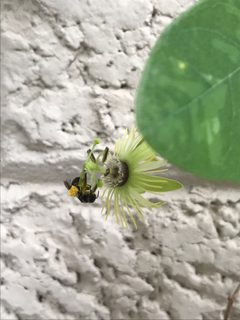
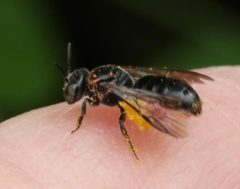
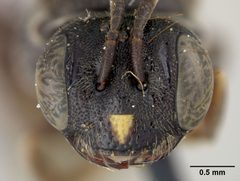
Protandrena are slender black bees, frequently with yellow markings on the and pronotum, occasionally with red on the metasoma, and rarely with green or blue tints. The forewings have two or three submarginal . Females possess a middle tibial spur that is finely toothed basally and becomes coarser distally (except in South American subgenus Austropanurgus, where it is finely toothed throughout). Males have a last abdominal sternum with paired large lobes constricted at the base. The gonostyli are more than half as long as the gonocoxites, with apices articulated or partly (except in South American subgenus Parasarus, where they are less than one-third as long).
Images
Habitat
Underground nesting in sunny areas with sparse vegetation. Nests are constructed in soil with lined by a chemical secretion that forms a protective barrier against microorganisms.
Distribution
From Canada through Argentina under broad circumscriptions; restricted to Canada through Panama if South American are excluded to other . Disputed southern boundary due to taxonomic disagreement about whether South American Protandrena belong to different genera.
Seasonality
Primarily active May to October; observed in April in region six of the United States.
Life Cycle
hatch and larvae develop underground, then overwinter as mature larvae with hardened skin.
Behavior
Solitary nesting is typical, though some nest in . Protandrena evansi exhibits communal social structure with multiple females sharing nests and showing tolerant toward both nestmates and non-nestmates. Nests are constructed with chemically-lined .
Ecological Role
. Some are floral (monolectic), including P. passiflorae on Passiflora lutea and P. abdominalis on Monarda punctata; others are .
Human Relevance
Subject to kleptoparasitism by cuckoo bees in the Holcopasites. P. passiflorae provides resource for studying specialization and conservation.
Similar Taxa
- PseudopanurgusMany historically or alternatively placed in Protandrena are classified here under some taxonomic systems, creating overlap in species composition between the two .
- AndrenaFacial similarities noted in etymology ('basic Andrena'), but distinguished by slender body form and specific genitalic and wing venation characters.
Sources and further reading
- BugGuide
- Wikipedia
- GBIF taxonomy match
- iNaturalist taxon
- NCBI Taxonomy
- Catalogue of Life
- Interactions between Females of Protandrena Evansi (Hymenoptera: Andrenidae), A Communal Nesting Bee
- Chromosome-level genome assembly of Protandrena ( Anthemurgus ) passiflorae (Hymenoptera: Andrenidae), a host-plant specialist bee
- Chromosome-level genome assembly of Protandrena ( Anthemurgus ) passiflorae (Hymenoptera: Andrenidae), a host-plant specialist bee