
Perdita punctosignata
Cockerell, 1895
Perdita punctosignata is a of mining bee in the Andrenidae, first described by Cockerell in 1895. It is one of approximately 800 described species in the Perdita, which comprises small, solitary bees native to North America. The species is known to occur in both Central America and North America, with three recognized distinguished primarily by coloration. Like other members of its genus, it is likely a , though specific plant associations remain undocumented.
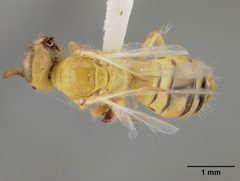
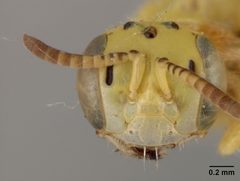
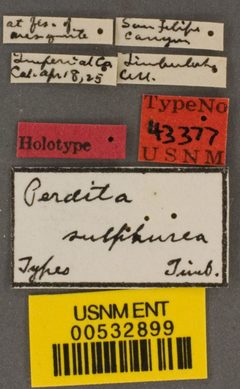
Pronunciation
How to pronounce Perdita punctosignata: //pɛrˈdiːtə pʌŋktoʊsɪɡˈneɪtə//
These audio files are automatically generated. While they are not always 100% accurate, they are a good starting point.
Identification
Identification to level requires examination of microscopic characters, including genitalia and punctation patterns on the . The specific epithet 'punctosignata' refers to distinctive punctate markings. Three are recognized based on color variation: the nominate form, P. p. flava (described as yellowish), and P. p. sulphurea (sulfur-yellow). Distinguishing Perdita punctosignata from requires reference to Timberlake's taxonomic revisions and comparison of male genitalia and facial markings.
Images
Distribution
Recorded from Central America and North America. Specific country records are sparse in available sources.
Similar Taxa
- Other Perdita speciesThe Perdita contains approximately 800 , many of which are morphologically similar small mining bees. Distinguishing P. punctosignata requires detailed examination of punctation patterns, facial markings, and male genitalia as described in Timberlake's revisions.
More Details
Subspecies
Three are recognized: Perdita punctosignata punctosignata (nominate form), P. p. flava Timberlake, 1964, and P. p. sulphurea Timberlake, 1964. These were described by Timberlake based on color variation.
Taxonomic history
The was first described by Theodore Dru Alison Cockerell in 1895. P.H. Timberlake provided subsequent taxonomic treatment, describing the two additional in 1964.
Sources and further reading
- BugGuide
- Wikipedia
- GBIF taxonomy match
- iNaturalist taxon
- NCBI Taxonomy
- Catalogue of Life
- Primary Type List | Entomology Research Museum
- You, Too, Can Plant a Pollinator Garden | Bug Squad
- 'Am I Even a Bee?' Identity Crisis Unfolds in This Charming Book | Bug Squad
- Researchers Develop Genome Map for Mojave Poppy Bee
- Bug Eric: World Bee Day....A Little "Bee"hind
- The best species name ever! | Beetles In The Bush