
Trioza adventicia
Tuthill, 1952
syzygium leaf psyllid, lillypilly psyllid, eugenia psyllid
Trioza adventicia is a sap-sucking hemipteran in the Triozidae that creates pit galls on leaves of Syzygium paniculatum. Native to eastern subcoastal Australia, this has been introduced to California, southern Australia, and New Zealand where it affects ornamental plantings. For decades it was misidentified as Trioza eugeniae in scientific literature, horticultural resources, and programs until a 2019 taxonomic revision using morphological and evidence clarified the distinction. The biological control program in the United States unknowingly targeted the correct species despite the nomenclatural confusion.
Pronunciation
How to pronounce Trioza adventicia: //ˈtraɪ.oʊ.zə ædˈvɛn.tɪ.siə//
These audio files are automatically generated. While they are not always 100% accurate, they are a good starting point.
Identification
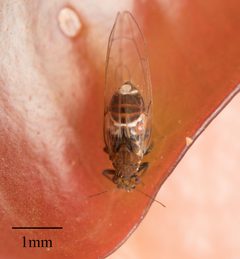
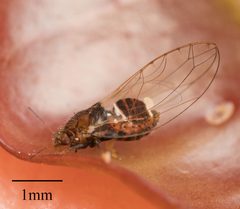
Distinguished from the similar Trioza eugeniae by wing shape and venation: T. adventicia has larger, more ovate fore wings with dark infuscation around R and R1, while T. eugeniae has smaller, more elongate fore wings lacking this infuscation. T. eugeniae has vein Rs relatively longer, meeting the closer to the wing apex, and possesses long, fine divergent setae on certain veins that T. adventicia lacks. Male paramere shape differs between . Metatibial spur count is unreliable for separation. confirms species distinction.
Images
Appearance
have larger, slightly more ovate fore wings compared to the similar T. eugeniae, with dark infuscation around R and R1. Vein Rs is relatively shorter, meeting the further from the wing apex. The wings lack long, fine divergent setae on certain veins. Male parameres are somewhat broadly pyriform with slightly more sclerotized apices. The metatibial spur configuration (typically two inner and one outer) is inconsistent and unreliable for separation. Nymphs develop within pit galls in leaves.
Habitat
Eastern subcoastal Australia in native range; introduced occur in urban and ornamental settings in southern Australia, New Zealand, and California where plants are cultivated.
Distribution
Native to eastern subcoastal Australia; introduced to southern Australia, New Zealand, and the United States (California).
Diet
Feeds on phloem sap of Syzygium paniculatum.
Host Associations
- Syzygium paniculatum - plantCreates pit galls in leaves; nymphal development occurs within galls
Life Cycle
Nymphs form pit galls in leaves of the plant. Specific details of , nymphal instars, and not documented in available sources.
Behavior
Nymphs induce pit gall formation in leaves, which stunts plant growth. Subject to nearly 30 years of taxonomic misidentification under the name T. eugeniae.
Ecological Role
Herbivore that induces gall formation on plants; serves as target for programs using imported agents.
Human Relevance
Significant pest of ornamental Syzygium paniculatum (lillypilly, brush cherry) in horticulture and landscaping. Target of programs in the United States, which successfully imported appropriate agents despite the being misidentified as T. eugeniae at the time.
Similar Taxa
- Trioza eugeniaeHistorically confused with T. adventicia for decades; distinguished by smaller, more elongate fore wings lacking dark infuscation around R and R1, longer vein Rs meeting closer to apex, presence of long fine divergent setae on certain veins, and narrowly pyriform male parameres with weakly sclerotized apices. T. eugeniae has restricted distribution in southern subcoastal New South Wales, Australia.
Misconceptions
Widely misidentified as Trioza eugeniae Froggatt, 1901 in ornamental plant industry, literature, and horticultural resources for approximately 30 years. This misidentification persisted in academic literature and practical applications despite the biological control program unknowingly targeting the correct .
More Details
Taxonomic History
A 2019 study using morphological evidence and confirmed T. adventicia and T. eugeniae as distinct , determined that the widespread introduced species on Syzygium paniculatum was T. adventicia, and designated a lectotype for T. eugeniae. The true T. eugeniae is only known from a small region of southeastern Australia.
Biological Control
Despite the taxonomic confusion, the program in the United States that operated under the name T. eugeniae was actually targeting T. adventicia, and successfully imported appropriate agents for this .
Sources and further reading
- BugGuide
- Wikipedia
- GBIF taxonomy match
- iNaturalist taxon
- NCBI Taxonomy
- Catalogue of Life
- Encyrtid Holdings | Entomology Research Museum
- Publications | Entomology Research Museum
- Trioza acuminatissima Archives - Entomology Today
- trioza-acuminatissima - Entomology Today
- Trioza brevigenae Archives - Entomology Today
- A New Psyllid Pest on Ornamental Trees in California
- Case of mistaken identity: resolving the taxonomy between Trioza eugeniae Froggatt and T. adventicia Tuthill (Psylloidea: Triozidae)