
Allokermes
Bullington & Kosztarab, 1985
oak kermes scales
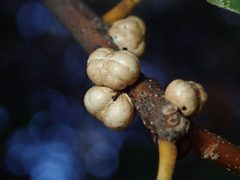
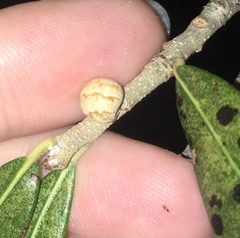
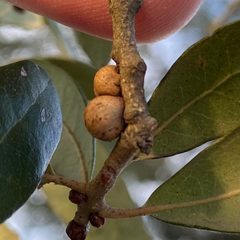
Allokermes is a of gall-like kermes scale insects in the Kermesidae, native to the United States and specialized on oak trees (Quercus spp.). Females are relatively large (4–5 mm), round, and mottled brown, while males are tiny (1 mm), white, and oval. The genus includes economically significant pests that cause branch dieback, reduced growth, and occasional tree mortality. At least two are well-documented: A. kingii in the southeastern and eastern United States, and A. galliformis in the eastern United States and Colorado.
Pronunciation
How to pronounce Allokermes: //ˌæloʊˈkɜːrmiːz//
These audio files are automatically generated. While they are not always 100% accurate, they are a good starting point.
Images
Habitat
Strictly associated with oak trees (Quercus spp.) in urban landscapes, nurseries, and street tree settings. Females occupy branches, tree wounds, bases of buds, and bases of leaf petioles; males occur in bark crevices along tree stems.
Distribution
United States. A. kingii occurs in the eastern and southeastern United States, including Florida. A. galliformis was originally known from the eastern United States (pin oak) and has been documented in Colorado along the eastern urban corridor adjacent to the Rocky Mountains.
Diet
Phloem-feeding; extracts sap from oak trees.
Host Associations
- Quercus spp. - primary -level association for all Allokermes
- Quercus geminata - A. kingii; sand live oak
- Quercus virginiana - A. kingii; live oak
- Quercus rubra - A. galliformis; northern red oak
- Quercus shumardii - A. galliformis; Shumard oak
- Quercus palustris - A. galliformis; pin oak
Life Cycle
time varies by and region. A. kingii has one generation per year throughout most of the United States, but two generations per year in Florida. Salmon-colored emerge late May through early August. Second instar females migrate to feeding sites, become , and secrete a hard waxy covering. Females to late August through mid-December; are laid in chambers early September through mid-December. Some second-generation crawlers emerge mid-September and molt to second instars by mid- October. First and second instar nymphs overwinter on trees. A. galliformis details have not been documented in the available sources.
Behavior
Females become permanently after selecting feeding sites and secrete a hard waxy covering. Males and females exhibit divergent settlement patterns: females migrate to larger branches, wounds, or new growth near leaf petioles, while males move to bark crevices on tree stems. Ants (Pheidole dentata has been observed) tend colonies and forage on honeydew secretions.
Ecological Role
Pest of oak trees causing branch dieback, flagging, reduced growth rates, and occasional tree death. Honeydew production supports growth and mutualists. Serves as for limited natural enemies including ladybird beetles, green lacewings, predatory caterpillars, and Metaphycus sp. A. galliformis facilitates the bacterial Lonsdalea quercina subsp. quercina, contributing to "drippy blight" with significant branch dieback, twig death, and gummosis.
Human Relevance
Significant pest of urban and landscape oak trees. A. kingii causes direct damage through feeding and indirect damage via . A. galliformis contributes to emergent drippy blight in Colorado, causing severe tree decline and mortality. Chemical control with acephate, bifenthrin, imidacloprid, and has shown limited effectiveness (less than 42% nymphal mortality).
Similar Taxa
- KermesAlso in Kermesidae; distinguished by taxonomic revision and associations, though specific morphological differences require examination
- other CoccoideaGall-like appearance and females resemble other scale insects; Allokermes distinguished by large female size (4–5 mm), oak-specific association, and waxy covering structure
Sources and further reading
- BugGuide
- GBIF taxonomy match
- iNaturalist taxon
- NCBI Taxonomy
- Catalogue of Life
- Life History of Allokermes galliformis (Hemiptera: Kermesidae) in Colorado
- Biology and Management ofAllokermes kingii(Hemiptera: Kermesidae) on Oak Trees (QuercusSPP.)
- Drippy Blight, a Disease of Red Oaks in Colorado, U.S., Produced from the Combined Effect of the Scale Insect Allokermes galliformis and the Bacterium Lonsdalea quercina subsp. Quercina