
Kermesidae
Gall-like Scales, Kermes Scales
Genus Guides
2- Allokermes(oak kermes scales)
- Olliffiella
is a of scale insects in the superfamily Coccoidea, comprising approximately 100 in 10 . Members are commonly known as gall-like due to the resemblance of females to plant buds or galls. The family is notable for its historical significance in dye production—certain Kermes species yield a red dye called kermes or crimson. is pronounced: males are small, winged, and gnat-like, while females are , bulbous, and often mistaken for plant structures. The family occurs primarily in the Nearctic, Palaearctic, and Indomalayan realms, with most species associated with oak trees (Quercus spp.).
Pronunciation
How to pronounce Kermesidae: //kɛɹˈmiːsɪˌdiː//
These audio files are automatically generated. While they are not always 100% accurate, they are a good starting point.
Identification
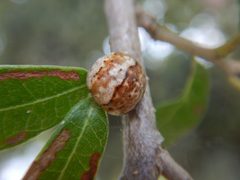
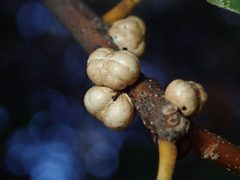
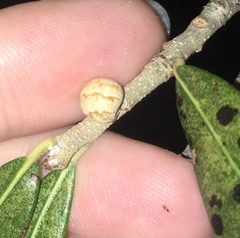
females are , bulbous, and gall-like in appearance, often mistaken for plant buds or galls; they have reduced legs and . Adult males are small, delicate, gnat-like insects with fragile wings. First-instar nymphs ("") are minute (<0.5 mm), salmon-colored, wingless, and possess well-developed legs for . The can be distinguished from other Coccoidea by the combination of extreme and the gall-like appearance of adult females. Specific require microscopic examination of morphological features for definitive identification.
Images
Habitat
Primarily associated with woody plants, especially oaks (Quercus spp.); found in bark crevices of tree trunks and thick branches. Some occur on thinner branches at high densities. specificity varies by species, with documented associations including Quercus robur, Q. geminata, Q. virginiana, and Q. ilex.
Distribution
Nearctic, Palaearctic, and Indomalayan realms. Documented occurrences include: Europe (Poland, Greece, Denmark, Norway, Sweden), Israel, United States (including Florida and Colorado), and other regions with suitable oak trees. Individual have more restricted ranges; for example, Kermes quercus is widespread in European-Siberian fauna but absent from southern Europe.
Diet
Phloem-feeding; documented associations are primarily with oaks (Quercus spp.), including Q. robur, Q. geminata, Q. virginiana, and Q. ilex. Some are serious local pests at high densities, causing branch dieback, flagging, reduced growth rates, and occasionally tree death.
Life Cycle
patterns vary by and geography. Some species are (one per year), while others are semivoltine (two-year generation). Allokermes kingii has one generation per year throughout most of the United States, but two generations per year in Florida. Kermes quercus in Poland has a semivoltine cycle: first-instar nymphs overwinter in year one, develop through spring and summer, moult to second-instar in late August, and overwinter again; appear in May of year two, with in June and new first-instars appearing in mid-June. First-instar nymphs are mobile "" that disperse before settling to feed.
Behavior
First-instar nymphs are active dispersers with well-developed legs, sometimes called "." females are and remain permanently attached to plants. Some produce large quantities of viscous honeydew that coats host plants and dribbles down trunks. Dead post-reproductive females may remain attached to host branches for more than one year. Winter occurs as nymphs (first or second instar depending on species).
Ecological Role
Phloem-feeding herbivores that can become serious local pests of oaks at high densities. Serve as for (Hymenoptera: Chalcidoidea, including Encyrtidae), with documented parasitoid including Psilophrys and Microterys. At least 13 parasitoid have been documented from five Kermes species in Israel alone, including four species new to science.
Human Relevance
Historical source of kermes dye (crimson) from certain Kermes , used for textile coloring before synthetic dyes. Some species are economically significant as pests of ornamental and forest oaks, causing branch dieback, reduced growth, and occasional tree mortality. Management efforts have included applications (acephate, bifenthrin, imidacloprid, ), though efficacy has been limited with <42% mortality reported in some studies.
Sources and further reading
- BugGuide
- Wikipedia
- GBIF taxonomy match
- iNaturalist taxon
- NCBI Taxonomy
- Catalogue of Life
- Life history of Kermes quercus (LINNAEUS) (Hemiptera: Kermesidae) in Poland
- Life History of Allokermes galliformis (Hemiptera: Kermesidae) in Colorado
- The parasitoid species (Hymenoptera: Chalcidoidea) of five Kermes species (Hemiptera: Coccoidea: Kermesidae) in Israel
- Morphological and molecular taxonomy of Nidularia balachowskii Bodenheimer (Hemiptera, Coccoidea, Kermesidae) with notes on its life history in Israel
- Biology and Management ofAllokermes kingii(Hemiptera: Kermesidae) on Oak Trees (QuercusSPP.)
- Data on the ecology of Kermes echinatus Balachowsky (Hemiptera, Coccomorpha, Kermesidae) on Quercus ilex (Fagaceae) in Greece
- Figure 1 from: Spodek M, Ben-Dov Y, Ghanim M, Mendel Z (2012) Morphological and molecular taxonomy of Nidularia balachowskii Bodenheimer (Hemiptera, Coccoidea, Kermesidae) with notes on its life history in Israel. ZooKeys 254: 23-45. https://doi.org/10.3897/zookeys.254.3959
- The Western Palaearctic species ofPsilophrysMayr (Hymenoptera, Chalcidoidea: Encyrtidae), parasitoids of kermesids (Hemiptera, Coccoidea: Kermesidae) attacking oaks (Quercusspp.)
- Figure 2 from: Spodek M, Ben-Dov Y, Ghanim M, Mendel Z (2012) Morphological and molecular taxonomy of Nidularia balachowskii Bodenheimer (Hemiptera, Coccoidea, Kermesidae) with notes on its life history in Israel. ZooKeys 254: 23-45. https://doi.org/10.3897/zookeys.254.3959
- Figure 3 from: Spodek M, Ben-Dov Y, Ghanim M, Mendel Z (2012) Morphological and molecular taxonomy of Nidularia balachowskii Bodenheimer (Hemiptera, Coccoidea, Kermesidae) with notes on its life history in Israel. ZooKeys 254: 23-45. https://doi.org/10.3897/zookeys.254.3959
- Figure 4 from: Spodek M, Ben-Dov Y, Ghanim M, Mendel Z (2012) Morphological and molecular taxonomy of Nidularia balachowskii Bodenheimer (Hemiptera, Coccoidea, Kermesidae) with notes on its life history in Israel. ZooKeys 254: 23-45. https://doi.org/10.3897/zookeys.254.3959
- Redescription of Microterys chalcostomus (Dalman) (Hymenoptera: Chalcidoidea: Encyrtidae), a parasitoid associated with Phenacoccus aceris (Signoret) (Hemiptera: Pseudococcidae) and Kermes spp. (Hemiptera: Kermesidae), with comments on its host relationship
- Figure 5 from: Spodek M, Ben-Dov Y, Ghanim M, Mendel Z (2012) Morphological and molecular taxonomy of Nidularia balachowskii Bodenheimer (Hemiptera, Coccoidea, Kermesidae) with notes on its life history in Israel. ZooKeys 254: 23-45. https://doi.org/10.3897/zookeys.254.3959