
Pulvinaria vitis
(Linnaeus, 1758)
Cottony Grape Scale, Cottony Scale
Pulvinaria vitis is a thelytokous cottony insect native to Europe, now established across much of the Northern Hemisphere and beyond. It is a pest of grape and peach, with females on bark and producing large ovisacs containing thousands of in spring. The exhibits distinctive discontinuous growth and feeding patterns, with three nymphal instars and limited mobility after the first moult.
Pronunciation
How to pronounce Pulvinaria vitis: /pʊl.vɪˈnaː.rɪ.a ˈvɪ.tɪs/
These audio files are automatically generated. While they are not always 100% accurate, they are a good starting point.
Identification
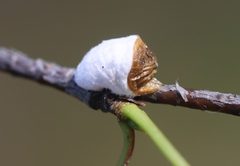
Distinguished from other Pulvinaria by association with Vitis and Prunus, thelytokous , and . The white felt-like ovisac produced in mid-May is characteristic. Specific morphological characters for separation from would require examination of microscopic features not detailed in available sources.
Images
Appearance
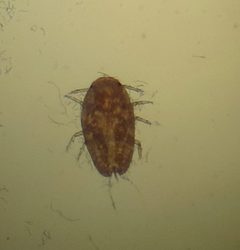
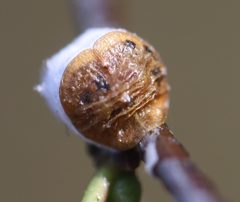
females are covered by a cottony, felt-like ovisac secreted from submarginal glands. The ovisac is white and encloses the . The body beneath is partly grown and flattened when . Newly emerged nymphs () are small, mobile, and phototactic.
Habitat
Orchards and vineyards; specifically on bark, leaves, and twigs of plants. occurs on bark of host trees.
Distribution
Native to Europe; introduced to North America prior to 1897. Present in Georgia, Russia, Israel, United States, United Kingdom, Ukraine, Turkmenistan, Turkey, Tajikistan, Switzerland, Sweden, Spain, Sardinia, Germany, Canada, China, Corsica, Crete, Denmark, Romania, Bulgaria, Czech Republic, Greece, Hungary, Iran, Ireland, Italy, Jordan, Japan, France, New Zealand, Portugal, Finland, Norway, Brazil, Netherlands, Morocco, Mongolia, Moldova, Luxembourg, Latvia, Kazakhstan, Algeria, Argentina, Armenia, Austria, Malta, Poland, and Australia.
Seasonality
females overwinter on bark. laid mid-May when temperatures reach 14°C or higher. Egg hatch occurs after approximately 200 day degrees above 10°C. Nymphal development continues through summer; third moult at 56–93 days post-hatching. Activity ceases in late August to early September.
Diet
Phloem sap; on twigs, stylets penetrate to xylem and destroy cambium in feeding area.
Host Associations
- Vitis vinifera - Grapevine; primary giving rise to specific epithet
- Prunus persica - Peach; significant economic in Ontario orchards
Life Cycle
(one per year). Partly grown female overwinters on bark. (~4,000 per female on peach) laid in mid-May within white felt-like ovisac. Egg hatch after ~200 day degrees above 10°C. Three nymphal instars: first moult at 12–18 days, second at 28–36 days, third at 56–93 days post-hatching. At , only and appendages are shed.
Behavior
Newly emerged nymphs are phototactic and photokinetic. Wind disperses at any active stage, especially early . Movement on plant is frequent until first moult, continuing sporadically through summer and early fall except during late August–early September. Feeding is discontinuous with periods of days without feeding. Limited from leaves to bark occurs; only small percentage of scales successfully reach bark from leaves.
Ecological Role
Herbivorous pest of cultivated fruit crops. Feeding damages phloem, xylem, and cambium tissues. Potential prey for and , though suppressed by orchard applications.
Human Relevance
Economic pest of grape and peach orchards. Managed through spray programs, which suppress natural enemy . potential exists but is often unrealized due to chemical management practices.
Similar Taxa
- Pulvinaria aurantiiCongeneric cottony with similar ovisac structure; distinguished by preferences and geographic distribution
- Parthenolecanium corniAnother Coccidae on stone fruits; lacks the characteristic cottony ovisac of Pulvinaria
More Details
Temperature-dependent development
development and hatching are strongly temperature-dependent. Hatching rate increases with temperature, though no close correlation exists between hatching rate and average daily temperature during the hatching period.
Population density limitation
For given environmental conditions, there appears to be a maximum number of nymphs that can establish per unit area of , suggesting -dependent settlement limitations.
Sources and further reading
- BugGuide
- GBIF taxonomy match
- iNaturalist taxon
- NCBI Taxonomy
- Catalogue of Life
- Encyrtid Holdings | Entomology Research Museum
- Curvature values, a new aspect in the morphology of grapevine seeds | Blog
- Waiter, there’s a fly on my fungus… | Beetles In The Bush
- Bug Eric: True Bug Tuesday: Mirid plant bug
- Exploring arctic plants and lichens
- Bug Eric: Spider Sunday: Sassacus
- Life History and Ecology of Pulvinaria vitis (L.) (Hemiptera: Coccoidea), the Cottony Scale Attacking Peach in Ontario